Most businesses already have product information.
The problem is that the information is often fragmented.
Specifications may be inside PDF catalogues. Datasheets may be stored separately. Engineering data may be inside technical tables or charts. Product descriptions may sit on the website. Inventory may live in spreadsheets or an ERP system. Application knowledge may only exist in the minds of experienced salespeople.
Humans can often work around this fragmentation.
AI needs better structure.
For businesses with complex products, the quality and organisation of product knowledge can have a major impact on the usefulness of an AI Agent.
1. Product Knowledge Is More Than a Catalogue
A traditional product catalogue may contain product names, images, descriptions and specifications.
That is a useful starting point, but an AI Agent helping customers choose complex products needs more context.
The Agent may need to understand how products relate to categories, which specifications matter, what applications the products support, how models compare and whether different products or accessories are compatible.
It may also need to retrieve deeper technical information from datasheets, charts, tables, manuals or engineering documents.
This broader context is what turns basic product data into usable product knowledge.
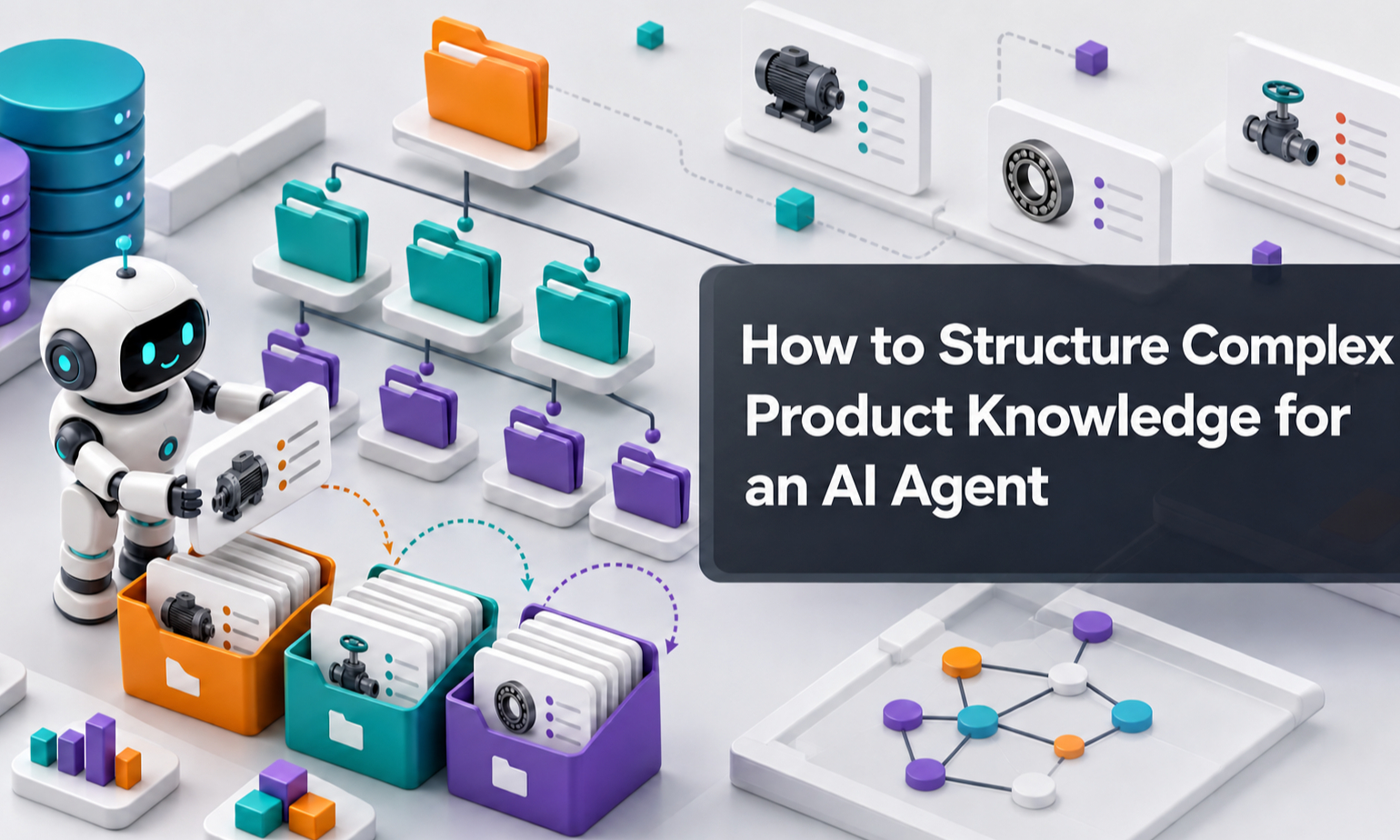
2. Start With a Clear Product Taxonomy
The first layer is the product structure.
Products should be organised into logical categories and subcategories that reflect how customers actually think about them.
A machinery business might organise products by equipment type. An electronics company might organise products by device category or application. A component distributor may organise products by function, specification or compatibility.
There is no universal taxonomy.
The right structure is the one that makes product relationships clear to both customers and AI.
3. Structure the Specifications That Drive Decisions
Different product categories require different specification fields.
A generator, pump, sensor and scientific instrument do not need the same data structure.
Businesses should identify which specifications customers and salespeople actually use when comparing products.
These may include dimensions, capacity, voltage, pressure, performance, power, material, operating range, environmental rating, accuracy, tolerance or other category-specific attributes.
The objective is not to capture every possible technical field.
The objective is to capture the fields that influence the buying decision.
4. Keep Datasheets, Technical Charts and Tables Available
Many complex products cannot be fully represented by simple specification fields.
Important information may live inside technical datasheets, performance curves, engineering tables, lifting charts, dimensional drawings or compatibility matrices.
These sources should remain part of the knowledge environment.
For example, a product page may contain the headline specifications, while a datasheet provides deeper technical detail. A performance curve may explain how output changes under different operating conditions. An engineering table may show limits that cannot be represented by one number.
For complex-product AI, these deeper sources can be essential.
5. Add Application Knowledge
Specifications tell the system what a product can technically do.
Application knowledge helps explain when the product is relevant.
This is important because customers frequently describe their use case rather than the product they want.
Businesses should therefore consider documenting common applications, typical environments, industries served, customer problems the product addresses and conditions where the product may not be suitable.
This allows the AI Agent to connect product facts with customer intent.
6. Capture Compatibility and Product Relationships
Complex products often exist within a broader system.
They may require accessories, attachments, consumables, batteries, components or other compatible products.
This relationship data should be made explicit where possible.
An AI Agent that knows two products exist does not automatically know whether they work together.
Where compatibility cannot be confirmed, the Agent should not guess.
It should ask for more information or escalate the enquiry.
7. Separate Stable Product Information From Changing Business Information
Product information and commercial information have different lifecycles.
Technical specifications may remain unchanged for years.
Pricing, inventory, delivery times and promotions may change frequently.
These types of information should therefore be handled differently.
Businesses should define which information the AI can state confidently, which information is indicative and which information requires confirmation.
This helps reduce inaccurate promises and keeps the Agent aligned with actual business operations.
8. Inventory Context Can Make the Agent More Useful
For many product enquiries, customers eventually ask whether an item is available.
Where supported, inventory or availability information can be provided to the AI Agent as part of the product context.
However, the accuracy and freshness of that information matter.
If availability cannot be guaranteed, the Agent should communicate that clearly and collect the enquiry for confirmation.
The goal is to make inventory information useful without creating false certainty.
9. AI Webstore Creates a Structured Product Environment
Antbuildz AI Webstore Suite helps businesses organise products into structured product and category pages.
These pages can contain product names, descriptions, specifications, applications, images and supported commercial or inventory information.
They can also point customers toward deeper technical documents such as datasheets, charts, manuals or other product resources.
The Webstore gives customers a clearer product-browsing experience while creating a structured product environment that works with Antbuildz AI Agent.
This means the same product information can support both discovery and customer conversation.
10. Structured Data and Documents Should Work Together
Not everything belongs inside a product field.
Businesses may still need technical manuals, engineering charts, installation guides, warranties, policy documents, brochures and FAQs.
These sources remain valuable.
The strongest knowledge environment therefore combines structured product information with unstructured technical content.
Structured data helps the AI understand the product clearly.
Documents provide deeper supporting knowledge.
The combination is especially important for products where customers depend on detailed technical information.
11. Good Knowledge Also Supports Search and AI Discovery
Clear product pages, descriptive product names, structured specifications, application information and supporting technical content can also make products easier for search engines and AI systems to interpret.
This does not guarantee a particular ranking or AI recommendation.
However, it creates clearer product-level information that search engines and AI systems can potentially understand, index and reference.
For businesses thinking about SEO and generative engine optimisation, this structured product environment becomes increasingly useful.
12. Product Knowledge Should Continuously Improve
Product knowledge is never finished.
New products are introduced, specifications change, questions evolve and customers expose gaps in existing information.
Conversation monitoring can therefore become useful feedback.
If customers repeatedly ask questions the Agent cannot answer well, the business has discovered a knowledge gap.
That gap can then be corrected.
Over time, the product knowledge becomes stronger.
13. Start With High-Value Products
Businesses do not need to structure the entire catalogue immediately.
It is often better to begin with the highest-value or highest-enquiry product categories.
Prepare the important specifications, applications, FAQs and technical resources. Define what salespeople normally ask before making a recommendation or quotation.
Then expand the structure over time.
A smaller catalogue with accurate, well-structured information is more useful than a very large catalogue filled with inconsistent data.
Better AI starts with better product knowledge.