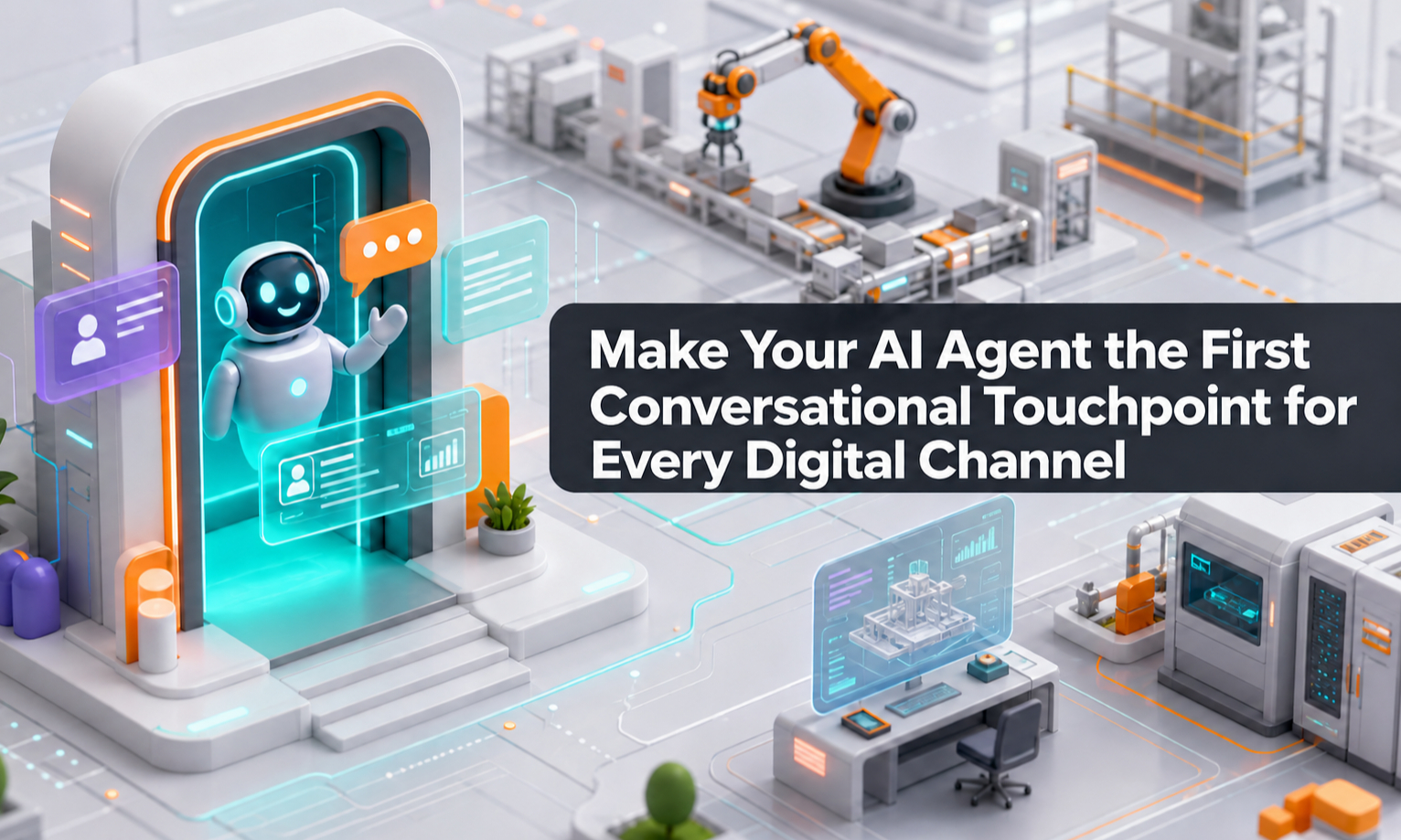
1. Digital Traffic Is Not the Same as a Customer Conversation
Most businesses already invest in generating traffic through websites, SEO, Google Ads, social media, email campaigns, product pages and online marketplaces.
But traffic alone does not create a useful sales opportunity.
For a simple product, the customer may only need to see a price and click Buy.
For a complex product, the customer may need to understand several things before they can move forward.
They might ask:
1. “Will this machine fit through my access door?”
2. “Which model operates within this temperature range?”
3. “Which pump meets this flow and head requirement?”
4. “Does this component work with my existing system?”
5. “Which of these products is suitable for my application?”
If the only next step is:
Contact Us
the customer still has to wait for someone to interpret the requirement.
Your AI Agent creates another option: Ask now.
2. From Digital Discovery to Conversation
A customer journey can begin almost anywhere.
It may start with a search engine, advertisement, LinkedIn post, product page, email campaign or QR code.
Those channels create discovery.
Your AI Agent can become the next step.
For example:
1. Google Search → Product Page → Ask Your AI Agent
2. Google Ad → AI Terminal → Explain Your Requirement
3. LinkedIn Post → AI Agent Link → Product Conversation
4. Email Campaign → Ask Our Product Specialist → AI Agent
5. Digital Catalogue → QR Code → AI Agent
6. Marketplace Listing → Product Interest → AI Agent Conversation
The channel brings the customer in.
Your Agent helps them move forward.
Antbuildz currently provides a dedicated, shareable AI Terminal that can be linked from websites, ads, social posts, emails and other marketing channels.
3. Why This Matters More for Complex Products
For complex products, the first conversation often involves much more than:
“How much?”
The customer may not know the exact product they need.
They may only know:
1. The application
2. Their operating conditions
3. Required capacity
4. Available space
5. Technical constraints
6. Required output or performance
7. Whether they want to buy or rent
For example:
“I need equipment that can lift 1,500kg to 6 metres, but the access door is only 2 metres wide.”
The right answer may require the Agent to understand several constraints at once.
It may need to identify:
1. Required load capacity
2. Required lift height
3. Machine width
4. Relevant configuration
5. Whether additional clearance matters
6. Whether another dimension also needs checking
The answer may not exist as one sentence in a datasheet.
Your AI Agent may need to retrieve the relevant specifications, reason across them together with the customer’s requirements, and determine whether to answer, ask another question or involve a specialist.
That is what turns traffic into a useful product conversation.
4. The AI Agent Does More Than Answer Questions
The value is not simply:
Customer asks → AI answers
For complex products, the Agent may need to manage a multi-step conversation.
A customer might begin with:
“I need a forklift for my warehouse.”
Your AI Agent may then need to clarify:
1. Required load capacity
2. Lift height
3. Aisle width
4. Indoor or outdoor operation
5. Available access width
6. Operating hours
7. Rental or purchase requirement
Delivery timing It can then retrieve relevant product information, reason across the requirements and narrow suitable options.
If enough information is available, it can provide supported guidance.
If something important is missing, it asks.
If the decision requires technical confirmation, it escalates.
The objective is to move the customer from:
“I am interested.”
to:
“Here is what I actually need.”
5. Website: Turn Browsing Into Conversation
For years, the website has been the main digital representation of a company.
Customers visit websites to understand the brand, browse products, compare information and decide what to do next.
That will remain important.
But for complex products, the website alone often leaves the customer with a navigation problem.
They may need to search through:
1. Product pages
2. Category pages
3. Datasheets
4. Specification tables
5. Manuals
PDF catalogues Your AI Agent adds a conversational layer on top of that information.
Instead of searching through everything themselves, customers can ask:
1. “Which models fit through a 2-metre doorway?”
2. “Which products support 24V DC and this communication protocol?”
3. “Which model should I compare for this application?”
This changes the website from a passive information source into a more guided product experience.
6. Your AI Agent Can Become the Digital Representative of Your Brand
The website represents your company through pages, design and information.
Your AI Agent represents your company through conversation.
The way it answers, explains products, asks questions, handles uncertainty and guides customers becomes part of the customer’s experience of your brand.
This matters because customers increasingly expect to ask instead of search.
Rather than learning how your website is organised, they can simply explain what they need.
For example:
“I need a machine that can lift 1.5 tonnes to 6 metres and fit through a 2-metre doorway.”
Your Agent can then understand the requirement, retrieve relevant product information, reason across the specifications and guide the customer toward the next step.
The website remains the digital foundation.
Your AI Agent becomes the conversational interface to that foundation.
Over time, that conversational layer may become one of the most important ways customers interact with your company online.
7. Advertising: Send Intent Into a Conversation
Many digital ads still send visitors to a generic homepage or landing page.
For complex products, that can waste the customer’s initial intent.
Someone clicking an advertisement may already have a specific application or technical requirement.
Instead of asking them to browse several pages and complete a form, the campaign can direct them toward your AI Agent.
For example:
Ad:
Need a pump for your application?
Call to action:
Ask our AI Product Specialist
The customer may then say:
“I need 80 m³/h at around 25 metres head.”
Your Agent can begin clarifying the requirement immediately.
The journey becomes:
Interest → Conversation → Clarification → Qualified Enquiry
instead of:
Interest → Landing Page → Browse → Form → Wait
8. Social Media: Turn Attention Into Product Conversations
Social media is good at generating attention.
It is less effective at structuring complex enquiries.
A business may publish:
1. New product launches
2. Demonstrations
3. Technical articles
4. Product comparisons
5. Case studies
Promotions An interested prospect may still need help before they are ready to contact sales.
A direct link to your Agent gives them somewhere to continue.
For example:
“Not sure whether this model fits your application? Ask our AI Product Specialist.”
The customer can move directly from consuming content to explaining what they need.
9. Email Campaigns: Move Beyond Passive Clicks
Email campaigns often direct readers to a product page, catalogue or contact form.
Your AI Agent can become another destination.
For example:
Not sure which model fits your requirement? Ask our AI Product Specialist.
A customer receiving a reach-truck campaign might ask:
“My aisle is 2.9 metres wide and I need to lift 1.5 tonnes to 8 metres. Which models should I compare?”
Now the campaign is doing more than generating a click.
It is generating a structured product conversation.
10. Product Pages and Digital Catalogues: Help Customers Interpret Specifications
A product page may contain all the correct specifications.
That does not mean the customer knows what those specifications mean for their situation.
A page may state:
Width: 1.82m
The customer wants to know:
“Can it pass through my 2m doorway?”
This is the difference between information and decision support.
Your AI Agent can retrieve the product dimension, compare it against the customer’s constraint and determine whether additional information is needed.
The same principle applies to:
1. Engineering tables
2. Technical datasheets
3. Performance charts
4. Compatibility matrices
5. Manuals
Product specifications For complex products, customers often need help converting technical information into a decision.
11. AI Webstore Suite: Structured Product and Inventory Intelligence
Your AI Agent can operate without AI Webstore Suite.
It can use approved business knowledge, catalogues, manuals, datasheets and other uploaded information.
But when AI Webstore Suite is connected, your Agent gains an additional structured product and inventory layer. Antbuildz describes AI Webstore Suite as the connected product, inventory and store layer that supports more accurate product recommendations.
This is different from normal document retrieval.
A Knowledge Base may tell your Agent: “Model X has a width of 1.82m.”
AI Webstore Suite can additionally provide structured information about:
1. Which products actually exist in your catalogue
2. Model and SKU relationships
3. Product categories
4. Structured specifications
5. Product variants
6. Sales or rental status
7. Pricing information
8. Inventory and availability
Product relationships
Dedicated product pages
This gives your Agent a stronger foundation for product queries and recommendations.
For example, a customer may ask:
“Which machines are available for rental, can lift 1.5 tonnes to 6 metres and fit through a 2-metre doorway?”
This may require three different types of intelligence:
Knowledge retrieval
Find the relevant technical information.
Reasoning
Compare the customer’s requirements against product specifications.
Structured product and inventory query
Identify which suitable products are actually in the catalogue and available.
That is where AI Webstore Suite becomes particularly powerful.
It is not simply another RAG source.
It can become a structured product and inventory intelligence layer for your AI Agent.
Antbuildz already positions the Webstore as the connected catalogue and inventory source used for more accurate product recommendations.
12. Knowledge Base and AI Webstore Suite Play Different Roles
Both are valuable, but they solve different problems.
Knowledge Base
Best suited for unstructured or document-based knowledge such as:
1. Catalogues
2. Datasheets
3. Manuals
4. Engineering tables
5. Policies
6. FAQs
7. Technical documentation
It helps your Agent understand what your documents say.
AI Webstore Suite
Provides structured product and inventory information such as:
1. Product identities
2. Models
3. SKUs
4. Categories
5. Structured specifications
6. Pricing
7. Inventory
8. Availability
Sales or rental status
Product pages
It helps your Agent understand what products you actually have, how they differ and what is available.
Together, they give the Agent both document intelligence and structured product intelligence.
This is especially important for complex-product businesses where a good recommendation may depend on both technical suitability and actual availability.
13. One AI Agent, Different Roles
Not every digital visitor has a sales enquiry.
The same Agent can take on different customer-facing roles.
Sales Specialist Clarifies buyer requirements, recommends supported products and captures buying intent.
Product Specialist Helps customers understand specifications, compare products and choose suitable options.
Customer Service Answers everyday customer and company questions.
Technical Support Uses specifications, manuals and technical documentation to support technical enquiries.
After-Sales Support Supports warranty, servicing, maintenance, spare parts and post-purchase questions.
Antbuildz currently defines these as roles of one configurable Agent rather than separate products.
This makes the first conversational touchpoint more useful.
The customer does not necessarily need to know which department they need before starting the conversation.
14. Your AI Agent Can Handle a Large Part of the Front-End Sales Conversation
For suitable workflows, your AI Agent can handle a substantial part of the repetitive front-end sales conversation before a salesperson becomes involved.
This can include:
1. Answering initial enquiries
2. Understanding the customer’s application
3. Clarifying specifications
4. Retrieving technical information
5. Reasoning across customer constraints and product data
6. Comparing supported products
7. Querying connected product and inventory data
8. Answering common commercial questions
Capturing buying intent
Collecting customer details
Qualifying the opportunity
Preparing the conversation for human handover
This can remove a significant amount of repetitive clarification from the sales team.
Your people can then focus on the parts where human judgement and authority matter most:
1. Technical confirmation
2. Engineering decisions
3. Quotations
4. Negotiation
5. Special pricing
6. Commercial approval
7. Customer relationships
8. Closing
A useful way to think about it is:
Your AI Agent handles the repetitive front-end conversation.
Your people handle the critical decisions and close.
15. From Anonymous Traffic to Qualified Context
Traditional lead forms often provide very little information.
A salesperson may receive:
Name
Email
“Need quotation.”
The salesperson then has to restart the conversation.
Your AI Agent can capture richer context during the enquiry.
For example:
Customer requires a 2.5-tonne electric forklift for indoor warehouse operation, approximately 5m lift height, restricted aisle width, three-month rental period and delivery next month.
That is far more useful.
The sales team can begin from an already clarified requirement instead of starting from zero.
16. Why This Is Especially Valuable for Global Traffic
Digital traffic does not follow office hours.
Customers may be researching at night, during weekends or from another time zone.
A static website remains available 24/7, but it cannot clarify a requirement.
Your AI Agent can continue supported conversations whenever customers arrive.
This does not mean every enquiry should be completed without a human.
It means the customer can begin the conversation, obtain supported information and provide useful requirements before your team becomes involved.
For companies serving customers across the US, Europe, Australia, Singapore, Hong Kong and other markets, this becomes increasingly useful.
17. The Agent Should Still Have Clear Boundaries
Making your Agent the first conversational touchpoint does not mean giving it unlimited authority.
Your Agent should not: 1. Invent specifications
2. Guess product compatibility
3. Confirm inventory unless reliable data is connected
4. Create unauthorised discounts
5. Make contractual commitments
6. Provide unsupported engineering conclusions
For complex or safety-critical questions, it should capture the requirement and involve the appropriate specialist.
The objective is not to remove humans.
It is to make the customer journey before human involvement far more useful.
18. How Antbuildz Powers Your AI Agent
Antbuildz provides the underlying system that allows your Agent to operate as your company’s digital representative.
The system combines:
Large Language Model
Understands natural language, conversation context and customer intent.
Approved Business Knowledge Provides the technical and company information your Agent is allowed to use.
Complex Knowledge Ingestion Supports catalogues, datasheets, manuals, specifications, tables, charts and other technical sources.
Retrieval Finds relevant information for the customer’s question.
Reasoning Connects customer requirements with product specifications and technical information.
AI Webstore Suite Optionally provides structured product, catalogue and inventory intelligence for more accurate product queries and recommendations.
Antbuildz Decision Layer Helps determine what information is missing, what should be retrieved, what needs to be compared, what question should be asked next and when human involvement is required.
Business Workflow Determines how enquiries should be qualified, captured, routed or escalated.
Together, these layers turn your Agent into more than a chat window.
It becomes a conversational layer between digital demand and your business intelligence.
19. The Future Digital Journey Is More Conversational
The traditional complex-product journey often looks like this:
Search → Website → Browse → Datasheet → Contact Form → Wait → Salesperson Starts Again
A more conversational journey looks like:
Search / Ad / Social / Email → Your AI Agent → Clarification → Product Reasoning → Inventory Match → Qualified Intent → Human Follow-Up
The website does not disappear.
It evolves.
Your website and AI Webstore Suite can become the structured digital foundation where products, specifications and inventory are organised and discoverable.
Your AI Agent becomes the interface customers talk to.
For complex-product businesses, that combination can create a much more useful digital experience.
Frequently Asked Questions
1. What does “first conversational touchpoint” mean? It means your AI Agent becomes the first place where a digital visitor can actively explain what they need and receive a guided response.
The customer may first discover your business through search, an advertisement, social media, email or a product page. The Agent then becomes the conversational layer that helps move that interest forward.
2. Can I link my AI Agent from advertisements and social media? Yes. Antbuildz provides a dedicated AI Terminal that can be shared through ads, social posts, emails and website links.
3. Can I embed my AI Agent on my website? Yes. Antbuildz supports deploying your Agent through your website as well as through a dedicated shareable AI Terminal.
4. Does my AI Agent need AI Webstore Suite? No.
Your AI Agent can work using approved business knowledge without AI Webstore Suite.
However, when AI Webstore Suite is connected, it adds a structured product and inventory layer that can support more accurate catalogue queries, product matching, availability checks and recommendations.
5. How is AI Webstore Suite different from a Knowledge Base? A Knowledge Base mainly provides document and business knowledge such as datasheets, manuals, policies and FAQs.
AI Webstore Suite provides structured product and inventory information such as models, SKUs, specifications, pricing, availability and product relationships.
Together, they give your Agent a stronger foundation for both technical reasoning and product recommendations.
6. Can my AI Agent reason across technical requirements? Yes.
Your Agent can retrieve approved product information and reason across it together with customer requirements.
For example, it can compare a doorway width against documented machine dimensions or compare operating conditions against supported product specifications.
7. Can my AI Agent handle most of the sales conversation? For suitable workflows, your Agent can handle a large part of the repetitive front-end conversation, including first response, requirement clarification, product guidance, comparison and lead qualification.
Human teams remain important for final technical confirmation, quotations, negotiation, commercial approval and closing.
8. Is the Agent only useful for sales? No.
Your Agent can also be configured for Product Specialist, Customer Service, Technical Support and After-Sales Support roles.
Conclusion
Complex-product businesses already invest heavily in generating digital traffic.
The missed opportunity is often what happens after the click.
Customers may still need help understanding specifications, explaining applications, comparing products, checking compatibility, clarifying requirements or determining what is actually available.
Your AI Agent can become the first conversational touchpoint for that traffic.
Whether the customer arrives from your website, Google, an advertisement, social media, an email campaign, a marketplace listing or a QR code, the objective is the same:
give them somewhere to ask.
Your Agent can then retrieve approved knowledge, reason across customer requirements and product specifications, ask the right follow-up questions, query structured product and inventory information where connected, capture useful context and guide the customer toward the appropriate next step.
And when AI Webstore Suite is connected, your Agent gains something beyond traditional RAG: a structured product and inventory intelligence layer that helps it understand what products exist, how they differ and what is actually available.
The website remains the digital foundation.
Your AI Agent becomes the conversation.
And for complex-product businesses, that conversation can become the bridge between digital discovery and real buying intent.