1. Not Every Product Conversation Is Simple
Some customer questions are straightforward:
1. “What are your opening hours?”
2. “Do you deliver?”
3. “Is this product available?”
Others are much more complicated:
1. “My doorway is 2.0 metres wide. Can this machine pass through?”
2. “Which pump can deliver this flow rate at this head?”
3. “Which model supports this operating temperature and communication protocol?”
4. “Can this machine lift this load at the required height?”
5. “Which replacement part is compatible with this model?”
These conversations require more than finding a sentence in a FAQ. The AI may need to understand the customer’s real-world requirement, identify which specifications matter, retrieve the relevant product information, reason across the customer’s requirement and the product data, compare several conditions at the same time, identify missing information and determine whether a supported recommendation can be made.
That is the type of conversation Antbuildz AI Agent is designed to support.
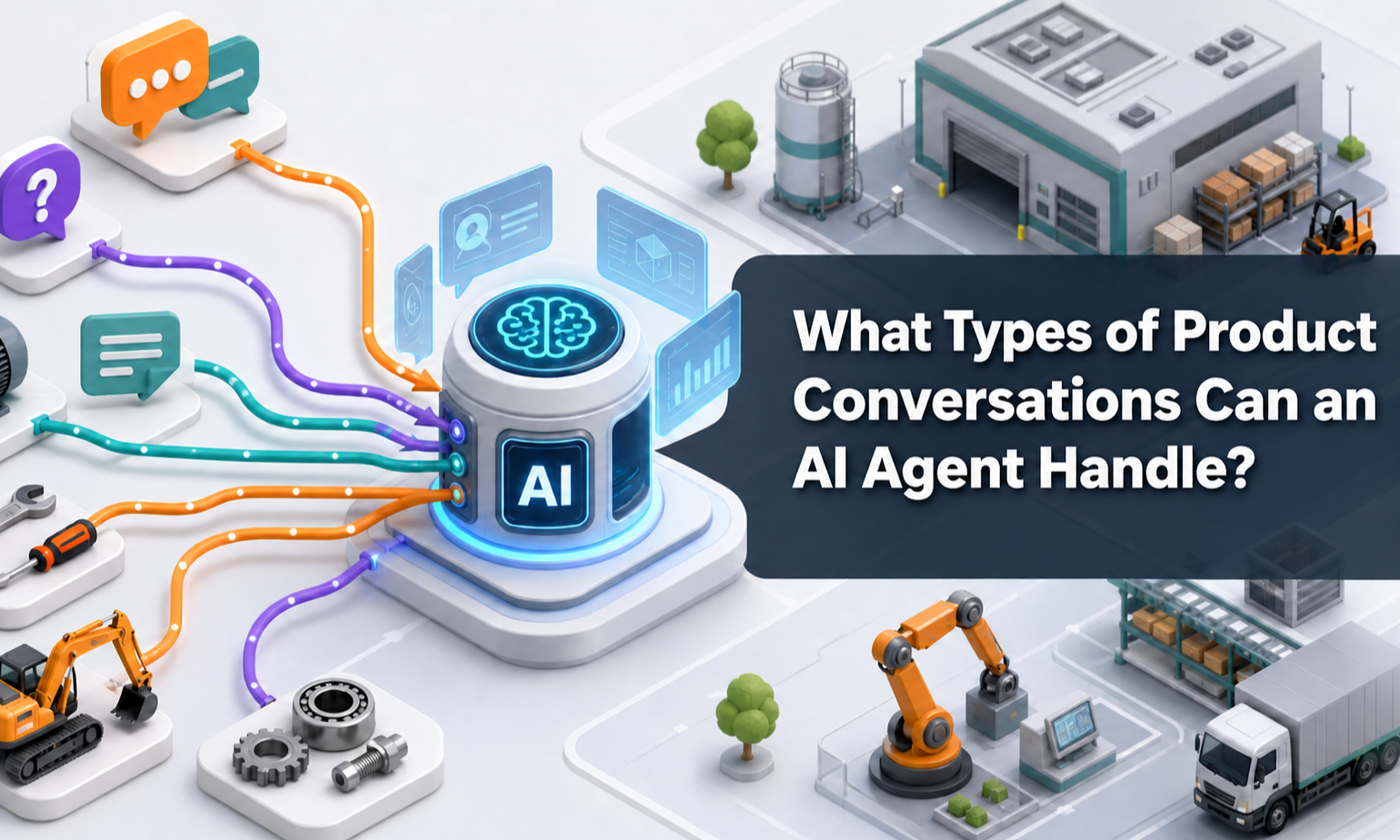
Depending on the knowledge, role and workflow configured, your AI Agent can handle conversations ranging from simple customer questions to complex technical and product-selection discussions.
2. Simple Product Questions
Not every conversation requires deep reasoning.
Customers may ask what a product does, what sizes are available, what models you carry, whether you sell or rent a product, whether an accessory is available, or where they can find a datasheet.
Your AI Agent can retrieve answers from approved product information and explain them conversationally. For businesses with large catalogues, this alone can reduce the time employees spend answering repetitive questions.
But this is only the starting point.
3. Product Discovery Conversations
Customers do not always know the exact product or model they need. They may simply describe what they are trying to achieve.
For example:
1. “I need something to measure distance accurately across a construction site.”
2. “I need a pump for transferring this type of liquid.”
3. “I need equipment to lift materials inside a warehouse.”
4. “I need a sensor that can operate in a high-temperature environment.”
Your AI Agent can interpret the requirement and determine which additional information is needed. Instead of forcing customers to navigate an entire catalogue themselves, the Agent can guide them through the decision.
This is especially useful for businesses with large product catalogues, many models or variants, technical specifications, multiple applications and compatibility requirements.
4. Complex Technical Specification Conversations
This is where Antbuildz goes beyond basic conversational AI.
Complex products often involve several technical specifications that must be considered together.
Selecting industrial equipment may depend on capacity, working height, width, reach, power source and operating environment. Selecting a pump may depend on flow rate, head, fluid type, temperature and material compatibility. Selecting an instrumentation or electronic product may involve voltage, measurement range, accuracy, communication protocol and environmental rating.
A customer may provide only part of this information.
Your AI Agent can identify what is missing, retrieve the relevant product specifications and reason across those specifications against the customer’s requirement.
The goal is not simply to match keywords.
It is to understand the relationship between the customer’s requirement and the product specifications.
5. From Information Retrieval to Product Reasoning
Retrieving the correct specification is only part of a complex product conversation.
Customers rarely ask questions exactly as they appear in a datasheet. They usually describe a real-world requirement and expect the Agent to determine whether a product fits.
For example:
“My doorway is 2.0 metres wide. Can this machine pass through?”
The product datasheet may only state:
Machine width: 1.82 metres
The answer is therefore not a direct lookup.
The Agent needs to retrieve the correct dimension, understand the customer’s 2.0-metre constraint and reason across both pieces of information.
Depending on the product, it may also need to consider whether attachments increase the overall width, whether the stated dimension applies to the correct configuration, whether additional clearance is required, or whether height and turning radius may also affect access.
This is the difference between finding information and using information to support a product decision.
Other examples include:
1. “I need to lift 1,500kg to 6 metres. Which model meets that requirement?”
2. “The machine needs to operate under a 2.4m ceiling. Which options should I compare?”
3. “I need 80 m³/h at 25 metres of head. Which pump should I consider?”
4. “My system is 24V DC. Which products are compatible?”
5. “The operating temperature reaches 70°C. Which sensor models remain within specification?”
These questions may require the Agent to understand the requirement, identify the relevant technical variables, retrieve the correct specifications, compare multiple conditions, reason across the information and decide whether to answer, ask another question or escalate.
That combination is central to complex-product AI.
6. Datasheet and Technical Document Conversations
For many complex-product businesses, important product knowledge is buried inside technical documents rather than simple webpage descriptions.
This may include technical datasheets, product catalogues, specification tables, engineering documents, manuals, charts, drawings, spreadsheets, application guides and product comparison documents.
Your AI Agent is designed to work with approved product documentation in its Knowledge Base.
This allows customers to ask questions such as:
1. “What is the maximum operating pressure shown in the datasheet?”
2. “Which model has the highest temperature rating?”
3. “What does the manual say about this maintenance interval?”
4. “Which configuration supports this voltage?”
5. “Can you compare these two models based on the specification table?”
The objective is not merely to retrieve information.
Where appropriate, the Agent can use that information together with the customer’s requirements to reason about suitability, compatibility or the next relevant question.
For engineering-critical or safety-critical decisions, original technical sources and qualified personnel should still be used for final verification.
7. Engineering Table and Chart Conversations
Some product decisions depend on more than a list of specifications.
They may involve performance tables, capacity charts, operating curves, engineering matrices, load charts, compatibility tables or selection tables.
For example:
1. “Can this equipment handle this load at this working height?”
2. “Which pump operates closest to this duty point?”
3. “Which configuration remains within the permitted operating range?”
In these cases, the Agent may need to interpret the customer requirement, retrieve the relevant engineering information and reason across both.
Antbuildz is designed for product environments where this type of technical information forms part of the knowledge required during a conversation.
The Agent should also recognise when the data is incomplete, ambiguous or requires specialist interpretation. The objective is not to guess. It is to use available engineering information intelligently and escalate when appropriate.
8. Product Comparison Conversations
Customers frequently want to compare several options.
They may ask:
1. “What is the difference between these two models?”
2. “Which one has a higher capacity?”
3. “Which model is better suited for indoor operation?”
4. “Which version supports this interface?”
Your AI Agent can retrieve approved specifications and compare meaningful differences such as capacity, dimensions, performance, operating range, features, compatibility, application and power requirements.
Where the customer has a specific requirement, the Agent can also reason across that requirement and the product specifications.
For example:
“I only have 2.5m of available height. Which of these two models can operate within that limitation?”
This is more useful than simply listing specifications side by side.
9. Product Recommendation Conversations
The customer may not want product information.
They may simply ask:
“Which product should I use?”
That requires a different type of conversation.
The Agent first needs to understand the customer’s requirements. It may need to ask about the application, required capacity, operating environment, physical space limitations, performance requirements, quantity, preferred configuration and whether the customer is buying or renting.
Your AI Agent can then retrieve relevant product information and reason across the available options.
The Agent should only narrow or recommend products where the available knowledge supports that recommendation. When information is insufficient, it should ask another question or refer the conversation to the appropriate specialist.
10. Structured Product and Inventory Conversations
Your AI Agent can operate using approved product and business knowledge without AI Webstore Suite.
However, when the optional AI Webstore Suite is connected, the Agent gains access to a more structured product and inventory layer.
This can include products and models, SKUs, categories, structured specifications, product variants, pricing, sales or rental status, inventory, availability and product relationships.
This allows the Agent to handle conversations that combine technical suitability with actual catalogue or inventory context.
For example:
“Which models can lift 1,500kg to 6 metres, fit through a 2-metre doorway and are currently available for rental?”
Answering this well may require three different capabilities:
Knowledge retrieval — find the relevant technical information.
Reasoning — compare the customer’s requirements against product specifications.
Structured product and inventory intelligence — identify which suitable products actually exist in the catalogue and may be available.
This is where AI Webstore Suite adds value beyond traditional document retrieval.
It is not required for the Agent to work, but it can provide a stronger foundation for accurate product queries, comparisons and recommendations.
11. Compatibility and Parts Conversations
Complex-product businesses frequently receive questions such as:
1. “Will this part fit my machine?”
2. “Which replacement model is compatible?”
3. “Does this accessory work with this version?”
4. “What replaced this discontinued part number?”
These conversations can involve model numbers, serial ranges, part numbers, superseded products, compatibility tables, kits, accessories and configuration rules.
Your AI Agent can use approved fitment and compatibility information to narrow relevant options.
In some cases, reasoning is required.
For example:
“My machine is this model, built in this year, with this controller. Is this part compatible?”
The Agent may need to combine several conditions rather than simply matching one part number.
For parts and aftermarket businesses, this can be particularly valuable because customers may arrive with incomplete product information.
12. Sales Conversations
Your AI Agent can also take on the role of a Sales Specialist.
Typical conversations include:
Which product should I buy?
Can you recommend a model?
How much does it cost?
Is it available?
Can I request a quotation?
What quantity can you supply?
Can you deliver to my location?
When can I receive it?
The Agent can clarify the requirement, retrieve and reason across relevant product information, and capture details such as customer information, application, quantity, location, timeline, budget, purchase intent and technical requirements.
The result is a more useful enquiry for the sales team to follow up.
13. Rental Conversations
Rental conversations introduce additional variables.
A customer may say:
“I need this equipment for three months.”
But the business may still need to understand the application, capacity, site location, rental period, delivery date, operating environment, quantity and availability.
The Agent may also need to reason about suitability.
For example:
“The access width at site is 2.1m and the required working height is 12m. Which available equipment should I consider?”
That requires more than retrieving a rental price.
Your AI Agent can clarify the technical and commercial requirements before the rental team confirms final availability, pricing and suitability.
14. Customer Service Conversations
Not every conversation needs to become a sales opportunity.
Customers may ask about operating hours, delivery process, return policies, documentation requirements, order procedures or how to contact the correct department.
Your AI Agent can be configured as a Customer Service Agent using approved company information, FAQs and policies.
If the conversation involves account-specific information or an exception that cannot be verified, the Agent can capture the relevant details and pass it to the team.
15. Technical Support Conversations
The same AI Agent can also operate as a Technical Support Agent.
Customers may ask:
How should this product be configured?
What does this error indicate?
What does the manual recommend?
What is the operating limit?
Which specification applies?
What maintenance procedure is required?
Does this operating condition remain within specification?
The Agent can use approved manuals, product documentation, technical specifications, troubleshooting information and service instructions to support the conversation.
Some questions may require reasoning across several technical conditions.
For example:
“The ambient temperature is 45°C and the equipment is running continuously. Is this operating condition still within the recommended range?”
The answer may require retrieving several pieces of technical information and interpreting them together.
For questions requiring engineering judgement, physical inspection or safety-critical confirmation, the Agent should escalate rather than make an unsupported decision.
16. After-Sales and Service Conversations
The customer journey continues after purchase.
Your AI Agent can support conversations involving warranty, servicing, maintenance, spare parts, consumables, replacement products, product documentation and service procedures.
For example:
“This component has reached the recommended service interval. Which replacement parts and maintenance steps apply?”
The Agent can retrieve the relevant approved documentation and guide the customer toward the next supported step.
17. One AI Agent, Different Roles
The important point is that these conversations do not require completely different AI products.
Antbuildz provides the core AI Agent system, while the Agent can be configured around different customer-facing roles depending on the job the business wants it to perform.
Sales Specialist Supports product discovery, requirement clarification, recommendation and lead qualification.
Product Specialist Explains products, specifications, comparisons and suitability.
Customer Service Handles everyday product and company conversations.
Technical Support Works with technical specifications, manuals and product documentation.
After-Sales Support Supports maintenance, warranty, servicing, parts and post-purchase conversations.
The business determines what role the Agent performs, what knowledge it can access, what rules it follows, what information it should collect, what level of reasoning it may perform and when a human should take over.
This allows your AI Agent to support a much wider range of businesses than a traditional sales chatbot.
18. From Simple Products to Complex Products
Antbuildz is strongly specialised in industrial and specification-heavy products.
But the system does not require every product to have engineering complexity.
The same Agent can answer straightforward questions about a simple product catalogue while also handling more technical conversations where multiple specifications or constraints need to be considered together.
For example:
Simple Product Question
“Does this drill come with a battery?”
The Agent retrieves the approved product information and answers.
Product Comparison
“What is the difference between the 18V and 20V models?”
The Agent compares the relevant product specifications.
Application-Based Conversation
“Which one is suitable for drilling into reinforced concrete?”
The Agent may need to retrieve product capabilities and reason across the application requirement.
Constraint-Based Conversation “My doorway is only 2m wide. Which models can pass through?”
The Agent needs to compare the customer’s physical constraint against product dimensions and may need to ask about configuration or clearance.
Complex Engineering Conversation “I need a pump that can achieve this flow and head while handling a corrosive fluid at this temperature.”
The Agent needs to reason across several interacting technical conditions before narrowing the relevant options.
The complexity of the Agent’s job grows with the complexity of the customer decision.
That allows Antbuildz AI to support both straightforward product businesses and highly technical product environments, while maintaining its strongest differentiation around complex products.
19. How Antbuildz Handles Different Levels of Conversation
Antbuildz AI Agent combines several layers.
Large Language Model Understands natural language, context and customer intent.
Approved Business & Product Knowledge Provides the Agent with the information it is allowed to use.
Complex Knowledge Ingestion Supports product knowledge from sources such as catalogues, datasheets, manuals, specification tables, charts, drawings and spreadsheets.
Knowledge Retrieval Finds the relevant technical or business information required for the current conversation.
Reasoning Uses the retrieved information together with customer requirements to evaluate relationships, constraints, compatibility and potential suitability.
This is what allows the Agent to answer questions where the result is not directly written in the source document.
Optional AI Webstore Suite When connected, AI Webstore Suite provides structured product and inventory intelligence in addition to the Agent’s document-based knowledge.
This allows the Agent to work not only with what technical documents say, but also with structured information about products, models, pricing, sales or rental status, inventory and availability.
For complex-product businesses, this can improve catalogue queries and recommendations where technical suitability and current product availability both matter.
Antbuildz Decision Layer The Decision Layer helps determine what the customer is asking, which specifications matter, what information is missing, what knowledge should be retrieved, what needs to be compared, whether clarification is required, whether a supported recommendation can be made, which workflow should be followed and when human confirmation is necessary.
Business Workflow Defines what should happen next — answer, qualify, recommend, capture, route or escalate.
Together, these layers allow the same AI Agent to handle very different levels of conversation complexity.
20. Retrieval, Reasoning and Decision-Making
A useful way to understand Antbuildz AI Agent is through three functions.
Retrieval Find the relevant information.
Example:
Product width = 1.82m
Reasoning Determine what that information means for the customer’s requirement.
Example:
Customer doorway = 2.0m
Product width = 1.82m The Agent evaluates whether the dimensions appear compatible and whether any additional clearance or configuration information is required.
Decision-Making Determine what should happen next.
For example, the Agent may answer based on available evidence, ask about attachments or configuration, check another dimension, compare another product, request additional information or escalate for technical confirmation.
That combination is significantly more useful for complex product conversations than retrieval alone.
21. What Should Still Be Handed to a Human?
An AI Agent should have clear boundaries.
Your AI Agent should escalate when a conversation requires engineering approval, safety-critical judgement, information not supported by approved sources, final compatibility confirmation where evidence is incomplete, physical inspection, special pricing approval, contractual commitments, custom quotations or exceptions outside configured business rules.
The objective is not for AI to answer everything.
The objective is for AI to handle what can be supported reliably and prepare the rest of the conversation for the right person.
22. What Types of Businesses Can Use Antbuildz AI Agent?
This range of conversation handling makes Antbuildz relevant across many complex-product businesses, including:
1. Equipment rental companies
2. Machinery manufacturers
3. OEMs
4. Dealers and distributors
5. Industrial suppliers
6. MRO businesses
7. Spare-parts suppliers
8. Building and engineering product companies
Instrument manufacturers
Test and measurement companies
Electronics distributors
Automation companies
Hardware and trade suppliers
Technical consumer-product brands
The common factor is not industry alone.
It is whether customers benefit from help understanding, comparing, choosing, using or supporting a product.
That is the market Antbuildz AI Agent is built around.
Frequently Asked Questions
1. What types of product conversations can my AI Agent handle? Depending on its configuration, your AI Agent can handle product questions, sales conversations, rental discussions, product comparisons, technical specifications, compatibility questions, customer service, technical support, spare parts and after-sales conversations.
2. Can my AI Agent answer questions from technical datasheets? Yes.
The Agent can work with approved datasheets, catalogues, manuals, spreadsheets, specification tables, charts, drawings and other supported product documentation.
The quality of the answer depends on the quality and availability of the underlying source information.
3. Can my AI Agent reason across product specifications? Yes.
Your AI Agent is designed not only to retrieve product information, but also to reason across customer requirements and approved product specifications.
For example, if a customer provides a maximum doorway width, operating temperature, required capacity or voltage requirement, the Agent can compare those constraints against relevant product information.
Where important information is missing, the Agent can ask additional questions before narrowing suitable options.
4. Can my AI Agent answer questions where the exact answer is not written in the datasheet? Yes, when the answer can be reasonably derived from approved information.
For example, a datasheet may state a machine width of 1.82m while the customer asks whether it can pass through a 2m doorway.
The Agent can retrieve the product dimension, compare it against the customer’s constraint and determine whether additional information such as configuration or clearance is required.
For engineering-critical or safety-critical conclusions, appropriate human verification should still be used.
5. Does my AI Agent need AI Webstore Suite? No.
Your AI Agent can operate using approved business knowledge, catalogues, datasheets, manuals and other supported sources without AI Webstore Suite.
However, when AI Webstore Suite is connected, it adds a structured product and inventory layer that can support more accurate catalogue queries, product matching, availability checks and recommendations.
6. How is AI Webstore Suite different from the Knowledge Base? The Knowledge Base mainly provides document-based and business knowledge such as datasheets, manuals, engineering information, FAQs and policies.
AI Webstore Suite provides structured product and inventory information such as models, SKUs, specifications, pricing, availability and product relationships.
Together, they can provide a stronger foundation for both technical reasoning and product recommendations.
7. Can my AI Agent understand engineering specifications? It is designed to support conversations involving technical and engineering information available in approved knowledge sources.
It can retrieve relevant specifications, reason across them against customer requirements, identify missing information and determine whether further clarification or human confirmation is needed.
8. Can my AI Agent handle simple products too? Yes.
A product does not have to be technically complex for the Agent to support it.
The Agent can answer simple product questions, explain options and support customer-service conversations while also handling deeper technical conversations when more reasoning is required.
9. Is my AI Agent only a sales agent? No.
Sales Specialist is one role.
The same AI Agent can also be configured as a Product Specialist, Customer Service Agent, Technical Support Agent or After-Sales Support Agent.
10. Can my AI Agent recommend products? Yes, where sufficient approved product information and customer requirements are available.
The Agent can clarify requirements, retrieve relevant specifications, reason across multiple conditions and help narrow suitable options.
When AI Webstore Suite is connected, it can also use structured product and inventory information to improve catalogue queries and recommendations.
When important information is missing or suitability requires specialist confirmation, the Agent should ask another question or escalate.
Conclusion
Customer conversations can range from a simple:
“Do you have this product?”
to a much more complex:
“My access width is 2m, I need to lift this load to this height, and the machine will operate indoors. Which models should I consider?”
The second question cannot be answered through retrieval alone.
It requires the AI to understand the requirement, identify the relevant specifications, retrieve the correct product information, reason across several constraints and determine what should happen next.
That is what Antbuildz AI Agent is designed to support.
Your AI Agent can answer straightforward product questions, work with technical documentation, reason across specifications and customer requirements, compare supported options, capture intent and escalate when specialist confirmation is required.
When the optional AI Webstore Suite is connected, the Agent can also use structured product and inventory intelligence to improve catalogue queries, availability checks and recommendations.
And because the same core Agent can take on different roles — Sales Specialist, Product Specialist, Customer Service, Technical Support and After-Sales Support — it is not limited to one part of the customer journey.
The strongest differentiation remains complex products.
But the capability is broader:
from simple questions to complex technical reasoning, your AI Agent turns product knowledge into useful customer conversations and better next steps.