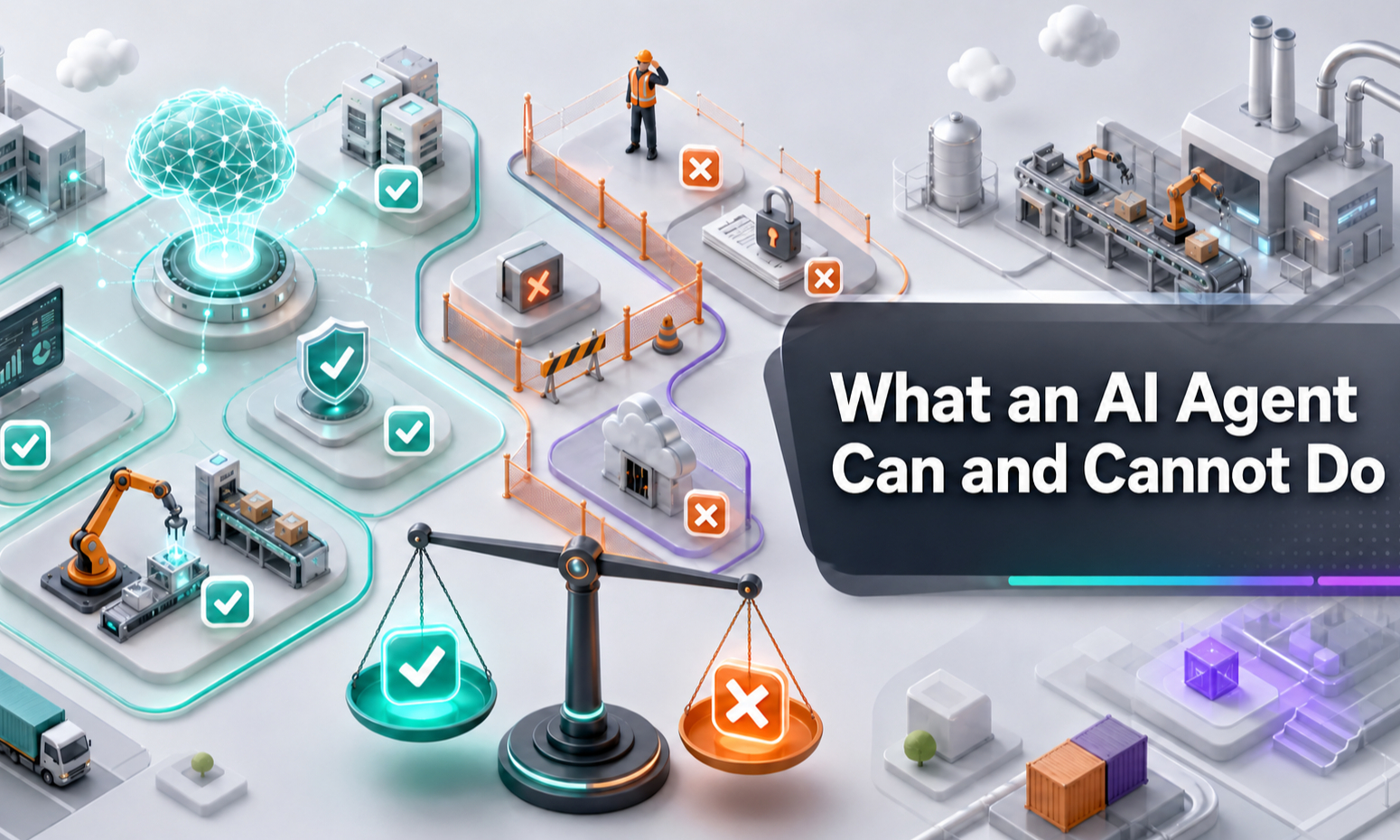
AI Agents Are Powerful — But They Need Boundaries
AI Agents can do far more than answer simple FAQs. For complex product businesses, they can understand natural-language questions, retrieve approved product knowledge, compare specifications, reason across customer requirements, ask follow-up questions and support different parts of the customer journey.
But an AI Agent should not try to answer everything.
A good AI Agent should know when it has enough information to respond, when it needs to ask another question, and when a human specialist should take over.
Antbuildz AI Agent is designed around this principle. It combines Large Language Model reasoning, approved product and business knowledge, knowledge retrieval, complex product data, business rules, the Antbuildz Decision Layer and defined human handover.
The goal is not to make AI sound confident.
The goal is to make it useful within clear boundaries.
What Your AI Agent Can Do
1. Answer Simple Product and Business Questions Your AI Agent can answer straightforward questions using approved business knowledge.
Examples include: 1. “What models do you sell?”
2. “Do you offer rental?”
3. “What are your opening hours?”
4. “Does this product come with this accessory?”
5. “Where can I find the datasheet?”
These questions usually require retrieval rather than complex reasoning. The Agent finds the relevant approved information and explains it conversationally.
2. Understand Natural Customer Requirements Customers do not always use exact product names or technical terminology.
They may say:
1. “I need something that can lift this load indoors.”
2. “I need a sensor that works in high temperature.”
3. “I need a pump for this liquid.”
Your AI Agent can interpret the intent behind the question and identify which technical variables may matter.
This makes the conversation more natural than forcing the customer through rigid forms or menus.
3. Ask Clarification Questions Complex product conversations are often incomplete.
For example:
“I need a forklift.”
That is not enough information to identify a suitable option.
The Agent may need to ask about load capacity, lift height, indoor or outdoor use, aisle width, operating hours and whether the customer is looking to rent or buy.
The ability to identify missing information is one of the most useful parts of an AI Agent.
4. Retrieve Product Knowledge Your AI Agent can work with approved product and business information such as:
1. Product catalogues
2. Technical datasheets
3. Manuals
4. Specification tables
5. Engineering charts
6. Drawings
7. Spreadsheets
8. Application guides
Product comparisons
FAQs
Company policies
Business rules
This gives the Agent a grounded source of information instead of relying only on general model knowledge.
5. Reason Across Customer Requirements and Product Specifications This is an important distinction.
The Agent does not only retrieve information. It can also reason across the information it retrieves.
For example:
“My doorway is 2.0 metres wide. Can this machine pass through?”
The datasheet may only state:
Machine width: 1.82 metres
The answer is not written directly in the source.
The Agent needs to understand that doorway width is the customer constraint, retrieve the correct machine width, compare the two values, check whether configuration or attachments affect width, consider whether additional clearance information is required, and decide whether it can answer or needs clarification.
That is reasoning over retrieved product knowledge.
Other examples include:
1. “I need 80 m³/h at 25 metres of head. Which pump should I consider?”
2. “My operating temperature reaches 70°C. Which sensors remain within specification?”
3. “I need to lift 1,500kg to 6 metres. Which models meet the requirement?”
“My system is 24V DC and requires this communication protocol. Which products are compatible?”
These questions require the Agent to use both customer constraints and product specifications.
6. Compare Products Your AI Agent can compare supported products using approved information.
For example:
“What is the difference between these two models?”
The Agent can compare capacity, dimensions, performance, features, operating conditions, compatibility, power requirements and applications.
It can also apply that comparison to a customer’s requirement.
For example:
“Which of these two models fits under a 2.4m ceiling?”
That requires more than listing specifications. It requires reasoning across the specification and the customer’s constraint.
7. Support Product Recommendations Where sufficient information is available, your AI Agent can help narrow suitable product options.
The Agent may first need to understand the application, capacity, environment, dimensions, compatibility, performance requirements, quantity and whether the customer intends to rent or buy.
It can then compare those requirements with supported products.
The important rule is simple:
Recommend only when the available information supports the recommendation.
If important information is missing, the Agent should ask another question.
8. Use Structured Product and Inventory Intelligence When Connected Your AI Agent can operate using approved Knowledge Base content without AI Webstore Suite.
However, when the optional AI Webstore Suite is connected, the Agent can also work with structured product and inventory information such as models, SKUs, specifications, pricing, sales or rental status, inventory and availability.
This becomes especially useful for questions such as:
“Which models meet these technical requirements and are currently available?”
or:
“Which available products can lift this load, reach this height and fit through this access width?”
These questions may require more than document retrieval.
The Agent may need to retrieve technical knowledge, reason across the customer’s requirements, and then use structured product or inventory information to identify relevant available options.
This gives the Agent a stronger foundation for product queries, comparisons and recommendations without relying only on RAG or document search.
9. Capture Buying Intent and Requirements Your AI Agent can also help turn a conversation into a more structured enquiry.
It may capture:
1. Customer details
2. Company
3. Product interest
4. Application
5. Quantity
6. Location
7. Timeline
8. Budget
Technical requirements
Rental period
Purchase intent
This creates a better handover to the sales or technical team.
10. Support Different Customer-Facing Roles Your AI Agent is not limited to sales.
The same core Agent can be configured as:
Sales Specialist
Clarifies requirements, supports product discovery and captures sales opportunities.
Product Specialist
Explains products, specifications and comparisons.
Customer Service
Answers everyday customer and company questions.
Technical Support
Uses technical documentation, manuals and specifications to support product-related questions.
After-Sales Support
Supports warranty, service, maintenance, spare parts and post-purchase conversations.
These are roles of one configurable Agent rather than separate products.
What Your AI Agent Should Not Do
1. It Should Not Invent Missing Specifications If the product documentation does not contain the required information, the Agent should not guess.
For example:
“What is the maximum operating temperature?”
If the approved knowledge does not provide that value, the correct response is to say the information is unavailable and request confirmation.
A confident but unsupported answer is worse than no answer.
2. It Should Not Treat General AI Knowledge as Product Truth A Large Language Model may know general engineering concepts.
That does not mean it knows the exact specification of a particular product.
General knowledge can help the Agent reason, but product-specific claims should come from approved product information.
For example, the Agent may understand the general relationship between flow and head, but the actual performance of a specific pump model should come from the relevant approved performance data.
3. It Should Not Guess Compatibility Compatibility questions can be risky.
For example:
“Will this part fit my machine?”
The Agent may need the exact model, serial number, manufacturing year, configuration, part number or compatibility table.
If the evidence is incomplete, the Agent should not assume compatibility simply because the products look related.
It should ask for additional information or escalate.
4. It Should Not Make Unsupported Engineering Decisions Some questions require engineering judgement rather than product-information reasoning.
For example:
1. “Is this structure safe to carry this load?”
2. “Can we operate outside the manufacturer’s stated limit?”
3. “Can I modify this product for this application?”
These questions may require qualified engineering review, site inspection, manufacturer confirmation or calculations outside the Agent’s approved scope.
The Agent can help retrieve relevant information and prepare the question.
It should not replace required engineering authority.
5. It Should Not Make Safety-Critical Decisions Without Appropriate Confirmation For safety-critical use cases, the cost of an incorrect answer can be high.
Examples include load limits, electrical safety, pressure systems, chemical compatibility, structural capacity, safety devices and regulatory compliance.
Your AI Agent can assist with approved technical information.
But where safety depends on interpretation, site conditions or engineering judgement, the Agent should involve the appropriate specialist.
6. It Should Not Confirm Inventory Unless the Data Is Reliable
An AI Agent should not say:
“Yes, this is available now.”
unless it has access to current and authorised inventory information.
If inventory is not connected or updated, the Agent should clearly state that availability needs to be confirmed.
The same applies to delivery dates, rental fleet availability, lead times and stock quantities.
When AI Webstore Suite is connected and maintained with current product and inventory information, your Agent can use that structured data as part of the conversation.
This helps it answer questions such as:
“Which suitable models are currently available?”
rather than relying only on static documents or general product knowledge.
The principle remains the same:
the Agent should only state availability when the underlying data supports it.
7. It Should Not Commit Pricing Outside Approved Rules The Agent may provide pricing where current and authorised pricing data and rules are available, including connected structured pricing where supported by AI Webstore Suite.
But it should not invent discounts, special pricing, project rates, negotiated terms or credit terms unless those rules have been explicitly configured.
Commercial authority still belongs to the business.
8. It Should Not Make Contractual Commitments An AI Agent should not independently commit the business to contract terms, warranties beyond approved policy, delivery guarantees, custom obligations, liability commitments or exceptions to company policy.
These require authorised human approval.
9. It Should Not Pretend Certainty When the Evidence Is Unclear This is one of the most important behaviours.
The Agent should be comfortable saying:
“I need more information.”
or:
“The available product information does not confirm this.”
or:
“This requires technical verification.”
Good AI behaviour is not about answering every question.
It is about knowing when not to answer beyond the evidence available.
Retrieval, Reasoning, Structured Product Intelligence and Decision-Making
A useful way to understand Antbuildz AI Agent is through four functions.
Retrieval Find the relevant information.
Example:
Machine width = 1.82m
Reasoning Determine what that information means for the customer’s requirement.
Example:
Doorway width = 2.0m
Machine width = 1.82m The Agent evaluates whether the product appears to fit and whether other conditions need to be checked.
Structured Product Intelligence
When AI Webstore Suite is connected, the Agent can also query structured catalogue, pricing and inventory information.
For example:
“Which models that meet this width requirement are currently available?”
This allows the Agent to combine technical suitability with actual product and inventory context.
Decision-Making
Determine what should happen next.
The Agent may answer based on available evidence, ask about attachments, check transport width, compare another product, request more information or escalate for technical confirmation.
The Antbuildz Decision Layer helps control this next-step process around the underlying LLM.
This is what separates a useful product AI Agent from a system that only searches documents and generates text.
Why Human Handover Matters
Human handover is not a failure of AI.
It is part of a well-designed AI system.
The Agent should handle the work that can be supported reliably and involve people when the conversation requires engineering judgement, commercial authority, physical inspection, exceptional cases, missing information, safety-critical confirmation or contractual commitments.
The goal is to use AI where it creates leverage without removing necessary human control.
The Right Boundary Depends on the Agent’s Role
Different roles require different boundaries.
Sales Specialist Can clarify requirements and capture buying intent.
Should escalate final pricing, special commercial terms and contractual commitments.
Product Specialist Can explain specifications and compare supported products.
Should escalate where product suitability cannot be confirmed from approved information.
Customer Service Can answer approved FAQs and company policies.
Should escalate exceptions and account-specific issues that cannot be verified.
Technical Support Can work with manuals, specifications and troubleshooting information.
Should escalate when engineering judgement, physical inspection or safety confirmation is required.
After-Sales Support Can support warranty, servicing, parts and maintenance conversations.
Should escalate exceptions, disputed claims and technical decisions outside approved policy.
This is why Antbuildz lets businesses define what the Agent should answer, what information it should collect and when people need to take over.
What Makes a Reliable AI Agent?
When evaluating an AI Agent for complex products, do not only ask:
“Can it answer this question?”
Ask several deeper questions.
Does it use the correct source?
The answer should come from approved product or business knowledge.
Can it reason across multiple pieces of information?
Complex product questions often require comparing customer constraints against several specifications.
Can it use structured product and inventory data when available?
For catalogue, pricing or availability questions, structured product information can provide a stronger foundation than document retrieval alone.
Does it recognise missing information?
The Agent should ask when the answer depends on information the customer has not yet provided.
Does it explain its conclusion clearly?
Where appropriate, the Agent should show which product information or conditions support the answer.
Does it know when to stop?
The Agent should escalate when the available evidence or its authority is insufficient.
That combination is far more important than simply making the conversation sound human.
Frequently Asked Questions
1. Can an AI Agent answer every customer question? No.
A well-designed AI Agent should answer questions within its approved knowledge, configured role and business rules.
When the available information is insufficient, it should ask for clarification or escalate.
2. Can my AI Agent reason, or does it only retrieve information? It can do both.
Your AI Agent can retrieve approved product information and reason across that information together with customer requirements.
For example, it can compare a customer’s maximum doorway width against a machine’s documented dimensions rather than simply returning the width from the datasheet.
3. Can my AI Agent make product recommendations? Yes, when sufficient approved product knowledge and customer requirements are available.
The Agent can clarify requirements, retrieve relevant product information and reason across supported options.
Where suitability is uncertain, it should request additional information or hand the conversation to a specialist.
4. Does my AI Agent need AI Webstore Suite? No.
Your AI Agent can operate using approved business knowledge, product catalogues, datasheets, manuals and other supported sources without AI Webstore Suite.
However, when AI Webstore Suite is connected, it provides a structured product and inventory layer that can help the Agent answer catalogue, pricing and availability questions more accurately and support stronger product matching and recommendations.
This does not remove the need for reliable data. If the connected information is incomplete or outdated, the Agent should still avoid making unsupported claims.
5. Can my AI Agent handle engineering questions? It can support engineering-related questions using approved specifications, manuals, tables, charts and other technical documentation.
However, questions requiring engineering approval, safety-critical judgement or information beyond the available evidence should be escalated to qualified personnel.
6. Can an AI Agent hallucinate? Yes. Large Language Models can generate incorrect or unsupported information.
This is why Antbuildz uses approved product knowledge, retrieval, structured data where available, configured rules and decision logic to control how the Agent handles product conversations.
No AI system should be treated as automatically error-free.
For important technical or commercial decisions, appropriate verification remains necessary.
7. Can my AI Agent operate without human staff? It can handle many supported conversations independently, but this does not remove the need for people.
Human teams remain important for technical confirmation, commercial approval, exceptions, negotiations, engineering decisions and other areas requiring authority or judgement.
Conclusion
The strongest AI Agent is not the one that answers the most questions.
It is the one that understands which questions it can answer reliably, which require more information and which should be handed to a human.
Your AI Agent can retrieve approved product knowledge, reason across technical specifications and customer requirements, compare supported products, ask clarification questions and guide the conversation toward the next step.
When the optional AI Webstore Suite is connected, it can also use structured product, pricing and inventory intelligence to strengthen catalogue queries, availability checks and product recommendations.
But the Agent should not invent specifications, guess compatibility, make unsupported engineering decisions or commit the business beyond its configured authority.
For complex-product businesses, that balance matters.
Good AI is not just about intelligence. It is about intelligence with boundaries.