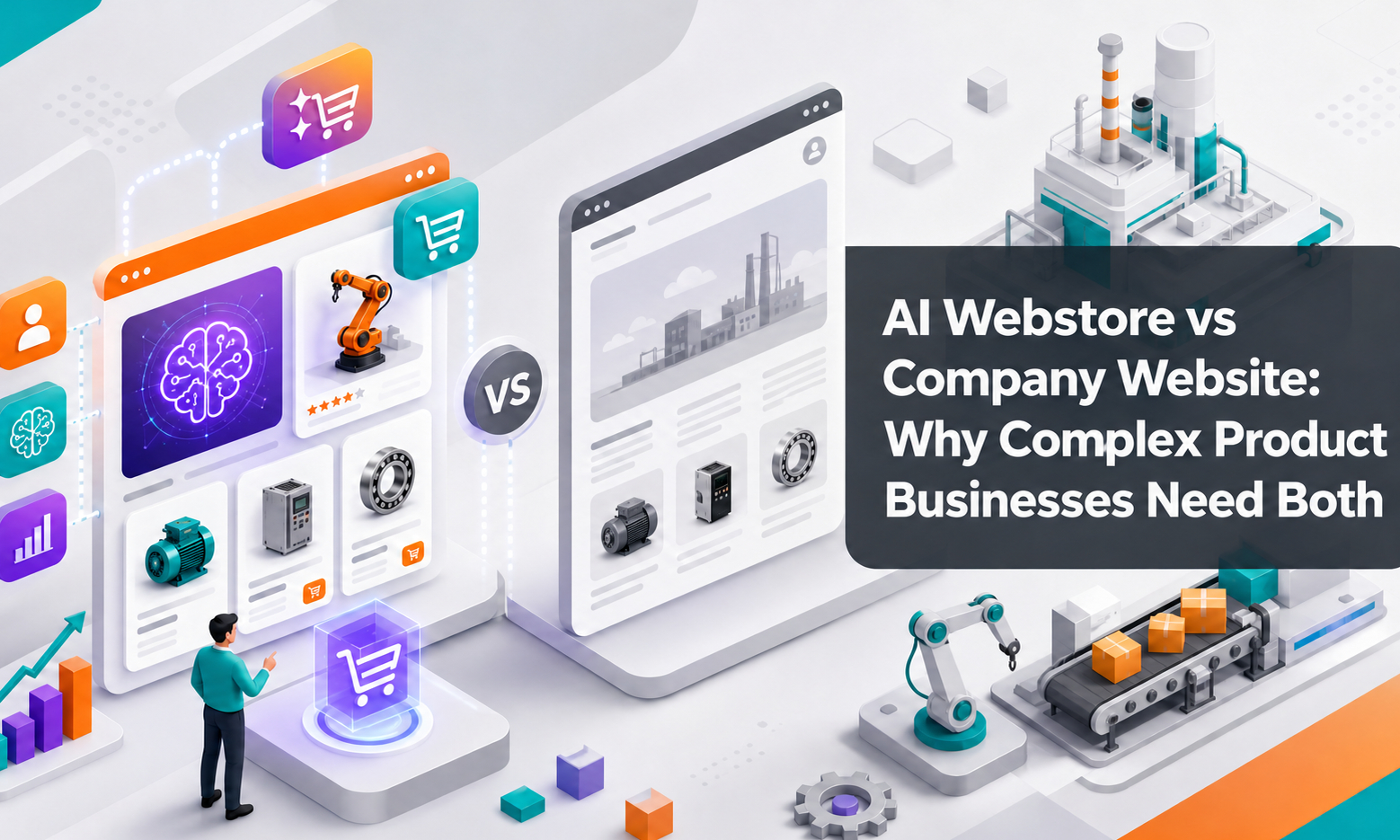
A traditional company website and an AI Webstore are not the same thing. A company website is usually designed to explain who the business is, what industries it serves, what services it provides and why customers should trust the company. It is an important part of corporate branding and communication.
But for businesses selling or renting hundreds or thousands of products, a traditional website often stops at a high level. It may show a few featured products, several product categories or a downloadable catalogue, but it is rarely designed to manage detailed product information, inventory, rental availability, pricing or complex sales workflows accurately.
This is where Antbuildz AI Webstore Suite serves a different purpose. The Webstore is designed to become the structured product, inventory and commerce layer of the business. It gives individual products their own pages, organises technical and commercial information, supports sales and rental workflows, and works closely with Antbuildz AI Agent to help customers discover, understand and enquire about the right products.
The objective is not necessarily to replace your company website. The objective is to give your products a proper digital home.
A Company Website Explains the Business
Most company websites are built around corporate information. They usually contain pages such as About Us, Services, Industries, Projects, Contact, Careers and perhaps a general Products section.
This is useful because customers want to understand the company before doing business with it. They want to know whether the supplier is credible, what markets it serves and what expertise it has.
But a corporate website is usually not designed to behave like a structured product system. A business may carry 2,000 products but only display 50 of them online. Product information may be manually created page by page. Inventory may be managed somewhere else. Rental availability may sit inside spreadsheets. Pricing may be updated manually. Technical documents may exist in separate folders.
The website tells the customer about the business, but it may not accurately represent the business’s full product catalogue or inventory.
An AI Webstore Is Built Around Products
AI Webstore Suite starts from a different place. Its centre of gravity is the product catalogue.
The Webstore can organise product categories, brands, models, specifications, images, documents, pricing, sales or rental status and supported inventory information in a structured environment.
That structure matters because the business no longer needs to treat every product as another manually created marketing page. The product becomes part of a managed catalogue.
This becomes increasingly important as the product range grows. Managing 20 products manually may be possible. Managing 2,000 products with changing specifications, pricing, availability and rental information becomes much harder.
A dedicated product system is designed for that problem.
Traditional Websites Display Products. Webstores Manage Them. A traditional website can certainly display products. There is nothing stopping a company from manually creating hundreds of product pages.
But displaying products and managing a product catalogue are different things.
A Webstore is designed around structured product records. If a business updates a specification, price, image or availability field, that information can be managed from the product catalogue rather than manually editing multiple marketing pages.
This gives the business a clearer and more scalable way to maintain product information.
For complex-product businesses, that difference becomes increasingly important because product data changes more often than corporate content.
Inventory Is Where the Difference Becomes Much More Important
A traditional company website usually contains general information.
It may say:
“We supply electric forklifts.”
But it may not accurately represent which models are currently carried, which products are for rental, which are for sale, what commercial options apply or what inventory information is available.
An AI Webstore is designed to hold much more structured product and inventory context.
The business can maintain information around specific models, specifications, sales or rental options, pricing, availability and other commercial details in one product environment.
This becomes especially important when the AI Agent starts recommending products.
The Agent should ideally understand not only that the company sells forklifts, but which forklifts actually exist in the catalogue and what relevant information is attached to them.
The Webstore Becomes the Product Layer Behind the AI Agent
Antbuildz AI Agent can operate independently using approved catalogues, PDFs, websites, FAQs and other company knowledge. It can answer questions, clarify requirements and recommend products based on that knowledge.
But when the AI Agent is connected to AI Webstore Suite, it gains a much more structured product environment.
The Agent can work with actual product categories, models, specifications, product pages, images, sales or rental status and supported inventory information.
This creates an important difference.
Without the Webstore, the AI Agent may recommend a product based mainly on text retrieved from documents.
With the Webstore, the Agent can recommend a structured product that actually exists inside the business’s catalogue and direct the customer toward the relevant product page.
The customer can then see the product image, review its details and continue toward the next commercial step.
Product Pages Make AI Recommendations More Useful
Imagine the AI Agent recommends a particular reach truck.
In a chat-only experience, the customer receives a text recommendation.
With the Webstore, the customer can open the actual product page and review the product visually. They can see the model, images, technical specifications, documents, sales or rental information and other relevant details.
This creates a much stronger customer experience.
The AI Agent helps the customer understand what may fit. The Webstore gives the customer something real to inspect.
For complex products, this combination is important because customers often want both explanation and visual confirmation before taking the next step.
The Webstore Can Work With Your Existing Website
Businesses do not need to choose between a company website and an AI Webstore.
The two can work together.
The company website can remain the primary corporate presence, while the Webstore becomes the structured product and commerce layer.
Customers can move from the existing website into the Webstore through navigation links, product links, buttons or embedded experiences. The AI Agent can also be deployed across the website and Webstore to create a more consistent customer journey.
This means businesses can keep their existing corporate website and branding while adding a much stronger product environment behind it.
The Webstore Can Also Become the Main Product-Facing Site
Some businesses may not need a large separate corporate website.
If most of the customer journey revolves around products, catalogue discovery, sales, rental and enquiries, the Webstore itself can become the main customer-facing experience.
The business can point its domain to the Webstore and use it as the primary product site while still including company information, policies, FAQs and other supporting content.
The important point is flexibility.
AI Webstore Suite does not force every business into the same structure. For some companies, it works alongside the existing website. For others, it can become the main product-facing digital presence.
Sales and Rental Workflows Go Beyond a Traditional Website
A normal product page often ends with a button such as:
“Contact Us”
But complex-product transactions usually involve much more than that.
A sales customer may need to provide quantity, delivery location, technical requirements or a quotation request. A rental customer may need to provide rental start date, duration, site location and delivery requirements.
These are not simply website functions. They are commercial workflows.
AI Webstore Suite is designed to support these kinds of sales and rental journeys, allowing customers to move from product discovery into enquiry, quotation, negotiation or booking processes.
That makes the Webstore much closer to a commerce system than a traditional corporate website.
Rental Businesses Need More Than a Website
The difference becomes even clearer for rental businesses.
A traditional website may show a list of equipment available for rental, but rental itself requires much more information.
The customer may need to specify start date, rental period, quantity, project location, delivery requirement and technical needs. The business may also need to manage catalogue information, pricing and availability context.
This is much closer to a rental operating workflow than a normal website page.
That is why a structured Webstore becomes especially valuable for rental businesses.
The Webstore Also Helps Build Product Discoverability
A corporate website may contain only a limited number of pages.
A Webstore can create dedicated pages for individual products.
If a company carries 1,000 products, that can potentially create hundreds or thousands of product-level entry points rather than only a handful of corporate pages.
Each product page can contain structured information around the brand, model, specifications, applications and commercial context.
This gives search engines and AI discovery systems a clearer understanding of what the business actually offers.
The customer may first discover a product and only then discover the company behind it.
This is one of the ways product presence can gradually strengthen brand presence.
The Webstore Is Also a Marketing Asset
Because every product can have its own page, the Webstore becomes useful across many marketing channels.
A company can direct Google Ads to a specific product instead of the homepage. Email campaigns can link directly to a product range. QR codes at exhibitions can open a particular product page. Salespeople can share a product link instead of sending another PDF.
The Webstore becomes a reusable destination across marketing and sales.
And because the AI Agent works with the same structured product environment, the customer can immediately ask questions about what they are viewing.
This connects marketing, product discovery and sales much more closely.
A Company Website and AI Webstore Serve Different Jobs
The simplest way to understand the difference is this.
A company website mainly answers questions such as: Who are you? What does your company do? Which industries do you serve? Why should customers trust you?
An AI Webstore answers a different set of questions: What products do you have? Which product may fit my requirement? What are the specifications? Can I rent or buy it? What alternatives are available? How do I enquire, negotiate or book?
Neither automatically replaces the other.
They solve different problems.
AI Webstore Suite Is More Than an Ecommerce Store
It is also important not to think of AI Webstore Suite as simply a standard ecommerce platform.
Traditional ecommerce is usually designed around product browsing and checkout.
Complex B2B sales often require more conversation. The customer may need technical clarification, product comparison, recommendation, rental periods, quotation, negotiation and human sales involvement.
That is why Antbuildz connects the Webstore closely with its AI Agent.
The Webstore provides the structured product and inventory layer. The AI Agent provides the conversational and recommendation layer. The sales team remains available for quotation, negotiation and closing.
The customer journey becomes:
Discover → Browse → Ask → Clarify → Match → Recommend → Enquire → Negotiate or Book
The Same Product Data Can Power the Store and the AI
This connected approach creates an important advantage.
The structured product information used to build the Webstore can also support the AI Agent.
The customer sees the product page. The AI Agent works with the product context. The sales team receives the resulting enquiry.
Instead of maintaining completely separate systems for website content, chatbot knowledge and product catalogue management, the same structured product environment can support multiple parts of the customer journey.
This creates a more consistent experience.
Frequently Asked Questions
1. Does AI Webstore Suite replace my company website? Not necessarily. Many businesses can continue using their existing company website and use AI Webstore Suite as the product, inventory and commerce layer.
2. Can the Webstore become my main website? Yes. For businesses that are highly product-driven, the Webstore can become the main product-facing site and be connected to the company’s domain.
3. What is the biggest difference between a company website and a Webstore? A company website mainly communicates corporate and marketing information. A Webstore is designed around structured products, catalogue management, inventory context and commercial workflows.
4. Does AI Webstore Suite include inventory management? Yes. The Webstore is designed to manage structured product and inventory information, with exact capabilities depending on the business setup.
5. How does the Webstore work with the AI Agent? The Webstore gives the AI Agent access to a more structured product environment, including actual products, specifications, product pages and supported inventory context.
6. Can I use the AI Agent without a Webstore? Yes. The AI Agent can operate independently using approved catalogues, documents, websites and other knowledge sources.
7. Does the Webstore support both sales and rental? Yes. The platform is designed to support businesses selling products, renting products or doing both.
Website for Your Brand. Webstore for Your Products. A company website remains important. It tells the market who you are, what your company stands for and why customers should trust you.
But when a business manages hundreds or thousands of products, a traditional website alone may not be enough.
The Webstore gives those products a structured home. It manages catalogue and inventory context. It gives individual products dedicated digital identities. It supports sales and rental workflows. And it gives the AI Agent a structured product environment it can use for better recommendations.
That is why the question should not be:
8. Website or Webstore? For many complex-product businesses, the better question is:
9. How should the website, Webstore and AI Agent work together? A useful way to think about it is:
Website for your company. Webstore for your products. AI Agent to connect customers with the right.