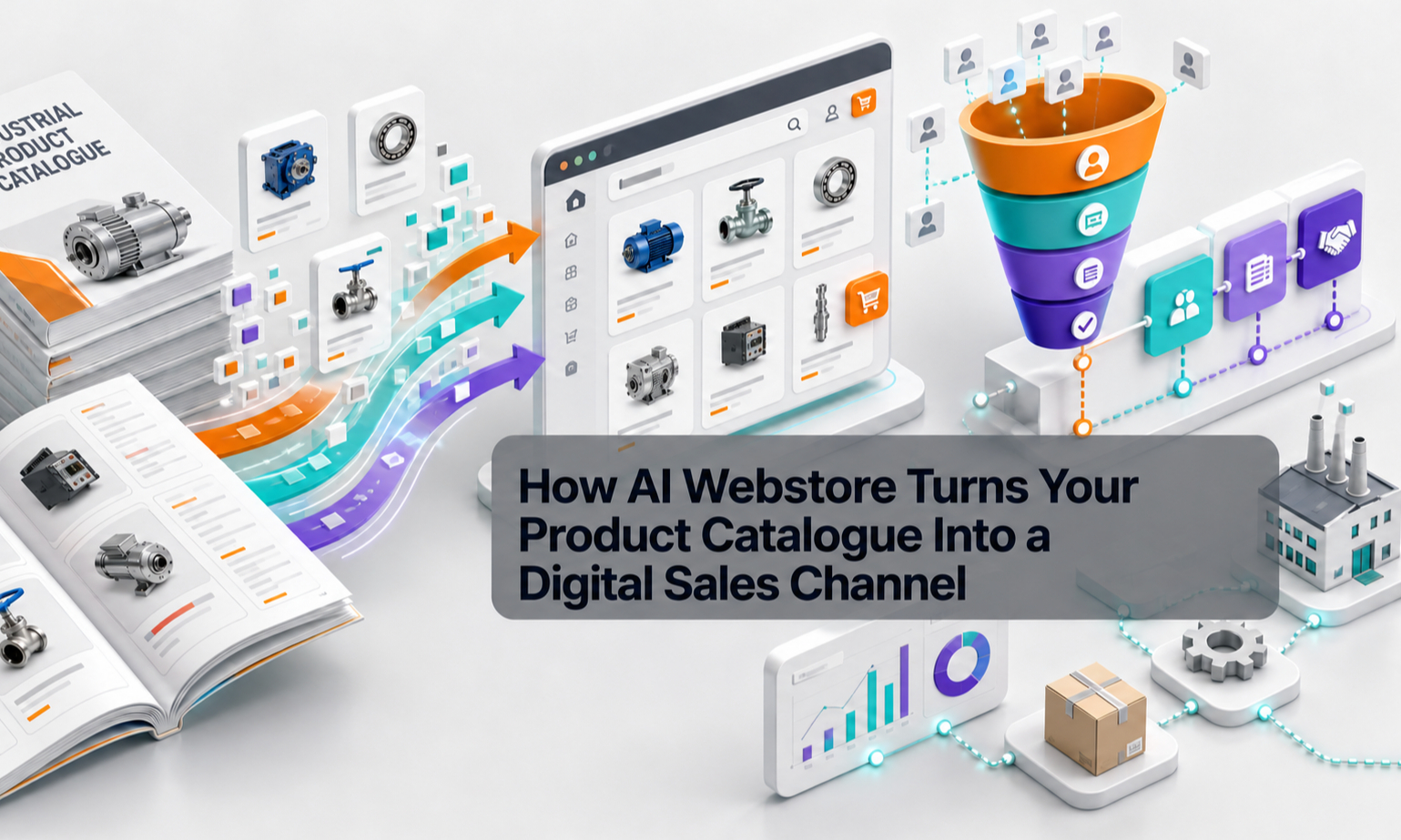
Many traditional businesses have strong products, experienced teams and years of industry knowledge.
But their digital presence often does not reflect that strength.
Products may be buried inside PDF catalogues, brochures, spreadsheets or a small number of company webpages. Search engines may struggle to understand exactly what the business offers. AI search platforms may have limited structured product information to work with. Buyers may discover competitors first, even when your products are equally suitable.
The result is a common problem:
You may have hundreds or thousands of products, but very little organic product presence online. Antbuildz AI Webstore Suite helps close this gap.
It turns your product catalogue into structured, dedicated product pages that can support search discovery, AI discovery and customer enquiries.
At the same time, those product pages become part of the product and inventory intelligence used by Antbuildz AI Agent.
The journey becomes:
Discover → Explore → Ask → Match → Recommend → Enquire
1. Why Traditional Businesses Struggle to Build Organic Presence
Many established businesses still rely heavily on:
- salespeople;
- referrals;
- distributors;
- exhibitions;
- paid advertising;
- existing customer relationships.
These channels remain important.
But they do not automatically build long-term digital visibility.
A company may carry 1,000 products while its website contains only 20 or 30 meaningful pages.
Most of the actual product knowledge remains hidden inside PDFs, spreadsheets or internal systems.
This creates a major digital gap.
Search engines have fewer pages to discover.
AI platforms have less structured information to understand.
Potential customers searching for specific products, specifications or applications may never find the business.
The company may be strong offline but almost invisible at the product level online.
2. Turn Every Product Into a Digital Asset
AI Webstore Suite helps businesses give individual products their own digital identity.
Each product can be organised around information such as:
- product name;
- brand;
- model;
- category;
- specifications;
- applications;
- images;
- technical documents;
- pricing where applicable;
- rental or sales options;
- inventory context;
- related products;
- enquiry actions.
Each product can also have its own dedicated URL.
Instead of keeping hundreds of products inside one catalogue, businesses can build hundreds of structured product pages.
For example:
Instead of:
company.com/catalogue.pdf
the structure becomes closer to:
company.com/product/electric-reach-truck-model-x
Now the product has a clear digital identity.
Search engines can understand it.
AI systems can interpret it.
Customers can discover it.
Salespeople can share it.
Marketing campaigns can link directly to it.
3. Build Your Brand One Product at a Time
This is where the value goes beyond product listing.
Every properly structured product page becomes another potential entry point into your business.
A customer may not search for your company name.
They may search for:
“1.5 tonne electric reach truck”
“8 metre warehouse reach truck”
“industrial pump for dirty water”
“air compressor for pneumatic tools”
“forklift rental near me”
If your product pages are structured around these products, applications and specifications, customers have more opportunities to discover your business organically.
The customer may first discover the product.
Then they discover the brand.
Then they explore related products.
Then they start a conversation.
Over time:
More product pages → More discovery opportunities → Stronger product presence → Stronger brand presence This is why AI Webstore Suite should not be viewed only as an ecommerce store.
It can become part of the company's long-term digital growth infrastructure.
4. Structured Product Pages Support SEO
Search engines work better when information is clearly organised.
Dedicated product pages can provide stronger signals around:
- product category;
- model;
- brand;
- technical specifications;
- applications;
- industry;
- use cases;
- related products;
- customer intent.
Instead of competing only for broad searches such as:
“forklift supplier”
the business can build visibility around more specific searches such as:
“2.5 tonne electric forklift”
“reach truck for 3 metre aisle”
“8 metre lifting reach truck”
“generator rental for construction site”
These more specific searches can be particularly valuable because the buyer often has a clearer requirement.
SEO results can never be guaranteed.
However, structured product pages create a much stronger foundation for search engines to discover, understand and index what the business actually offers.
5. Product Discovery Is Expanding Beyond Google
Customers are no longer using only traditional search engines.
They are increasingly asking AI-powered tools questions such as:
“Which forklift should I use for a narrow warehouse aisle?”
“What generator capacity do I need for my site?”
“What type of pump should I use for dirty water?”
“Which industrial cleaner is suitable for a 5,000 sqm facility?”
This changes how businesses should think about product visibility.
Your products should not only be understandable to traditional search engines.
They should also be clearly structured so AI-driven discovery systems can understand:
- what the product is;
- what it does;
- its specifications;
- its applications;
- who it is suitable for;
- how customers can obtain it.
This is where structured product pages become increasingly important.
6. From SEO to AI Discovery and GEO
Traditional SEO focuses on helping search engines understand and surface webpages.
Generative Engine Optimisation, or GEO, focuses on making information easier for AI-powered search and generative systems to understand.
For complex products, good product structure is especially important.
A strong product page should clearly explain:
What is the product? Its category, brand and model.
What can it do? Its use cases and applications.
What are its specifications? Capacity, dimensions, performance and technical details.
Who is it suitable for? Industries, applications and operating environments.
How can customers obtain it? Purchase, rental, quotation or enquiry options.
This gives digital systems significantly more context than a product name hidden inside a catalogue.
No platform can guarantee that Google, ChatGPT, Gemini or another AI system will rank, cite or recommend a particular product.
But structured product pages create a stronger foundation for both SEO and AI discovery.
7. Discovery Alone Does Not Create Revenue
Being discovered is only the first step.
A buyer still needs to understand:
- whether the product suits the application;
- whether another model may be better;
- whether the product is available;
- whether it can be rented or purchased;
- what specifications matter;
- what information is needed for a quotation;
- what the next step should be.
This is where many traditional websites stop.
They display information.
Then the customer has to work everything else out.
AI Webstore Suite is designed to connect product discovery with the next commercial action.
The journey becomes:
Product Discovery → Product Exploration → Conversation → Requirement → Recommendation → Enquiry This is what turns the Webstore from an online catalogue into a digital sales channel.
8. Add an AI Conversation Layer to Every Product
A product page cannot answer every possible customer question.
A customer may ask:
“Can this machine operate outdoors?”
Another may ask:
“Do you have something similar with higher capacity?”
Another may ask:
“Can I rent this for three months?”
Another may not even know which product they need.
This is where Antbuildz AI Agent becomes important.
The AI Agent can help customers:
- ask product questions;
- clarify requirements;
- understand specifications;
- compare products;
- identify suitable options;
- explore alternatives;
- provide rental or purchase intent;
- prepare an enquiry.
The Webstore gives the customer structured products to explore.
The AI Agent gives the customer a guided conversation.
9. Help Customers Search by Requirement, Not Just Product Name
Traditional websites usually work best when customers already know what they want.
But many B2B customers do not know the correct model or technical terminology.
They know the problem they need to solve.
For example:
“I need to lift pallets to an 8 metre rack.”
The customer may not know they need a reach truck.
Or:
“I need temporary power for three machines at my construction site.”
The customer may not know the correct generator capacity.
Or:
“I need something that can clean a large warehouse floor.”
The customer may not know whether they need a scrubber, sweeper or another machine.
The AI Agent can understand the customer's requirement and help connect that requirement with suitable products in the Webstore.
This changes the experience from:
Search by product name to:
Explain your requirement and discover suitable products
10. Structured Product Data Makes Recommendations More Useful
The Webstore is not only a customer-facing storefront.
It also becomes a structured product library for the AI Agent.
Consider a customer asking:
“I need an electric forklift capable of lifting 2.5 tonnes for indoor warehouse operation.”
A basic chatbot may explain what an electric forklift is.
Antbuildz can work with the business's actual product data.
The Agent can consider information such as:
- category;
- model;
- capacity;
- specifications;
- application;
- rent or purchase intent;
- location;
- pricing context;
- availability where connected.
It can then narrow the catalogue towards products that more closely match the customer's requirement.
The process becomes:
Understand → Query → Compare → Match → Recommend This is significantly different from simply retrieving a paragraph from a PDF and generating an answer.
11. Go Beyond RAG With a Product Decision Layer
Retrieval-Augmented Generation, or RAG, is useful for answering questions using approved knowledge.
For example:
“What is the lifting capacity of Model X?”
The AI Agent can retrieve the relevant information and answer.
But product recommendation requires more.
Imagine a customer asks:
“I need an electric reach truck that can carry 1,500 kg, lift to 8 metres and operate inside a 3 metre aisle. I need it for two weeks next month.”
The system needs to understand multiple requirements:
Capacity: 1,500 kg
Lift height: 8 metres
Operating environment: Indoor warehouse
Aisle requirement: Approximately 3 metres
Commercial intent: Rental
Rental duration: Two weeks
Timing: Next month
Then it needs to compare those requirements against the products the business actually offers.
This is a decision and matching problem.
Antbuildz AI Webstore Suite provides structured product and inventory context that can work together with the AI Agent's decision layer.
This allows the Agent to move beyond:
“Here is some information about reach trucks.”
towards:
“These products from your catalogue are the closest match to the customer's technical and commercial requirements.”
12. Product Matching Can Include Commercial Context
Technical suitability is only part of a B2B transaction.
Imagine five products technically match the customer's requirement.
But:
- one is unavailable;
- one is only available for sale;
- one cannot be supplied to the customer's location;
- two are suitable for the required rental period.
A useful product recommendation should consider more than specifications.
Depending on the available connected data, the system can also consider factors such as:
- inventory;
- availability;
- rental or purchase options;
- quantity;
- location;
- pricing;
- rental duration;
- delivery requirements.
This helps the AI Agent identify products that are not only technically suitable but also more commercially relevant.
13. Sales and Rental Businesses Need Different Workflows
Not every B2B transaction ends with “Add to Cart”.
A sales customer may need to provide:
- product requirement;
- quantity;
- specification;
- delivery location;
- purchase timeline;
- quotation request.
A rental customer may need to provide:
- equipment requirement;
- rental start date;
- duration;
- project location;
- capacity;
- application;
- delivery requirements.
Antbuildz AI Webstore Suite is designed to support both sales and rental businesses.
Businesses can create customer journeys that better match how complex products are actually sold or rented.
This can include:
Product discovery → AI conversation → Product matching → Enquiry → Quotation or negotiation rather than forcing every transaction into a conventional ecommerce checkout.
14. Turn Every Product Page Into a Marketing Entry Point
A structured Webstore also gives businesses better destinations for marketing.
Instead of sending every campaign to the company homepage, businesses can direct customers to:
- specific product pages;
- categories;
- brands;
- product ranges;
- applications;
- rental products;
- sales products.
These pages can then be shared through:
- Google;
- AI search;
- email campaigns;
- LinkedIn;
- WhatsApp;
- paid advertising;
- QR codes;
- exhibitions;
- brochures;
- sales proposals.
Every product becomes another possible entry point into the business.
This creates a much wider digital footprint than relying only on a corporate homepage.
15. Build Organic Brand and Product Presence Over Time
Paid advertising stops when the advertising budget stops.
Product pages can continue to form part of the company's digital presence.
As more products are added, the business gradually creates more structured pages around:
- brands;
- categories;
- models;
- specifications;
- industries;
- applications;
- customer problems;
- buying intent;
- rental intent.
Instead of having only a handful of corporate pages representing the entire company, a business can build hundreds or thousands of product-level digital assets.
This can increase the number of opportunities for customers to discover the business organically.
More importantly, it builds the brand around what the company actually sells.
A customer may first discover one product.
Then the brand.
Then several related products.
Then the AI Agent.
Then the business receives an enquiry.
The journey becomes:
Product Discovery → Brand Discovery → Product Exploration → AI Conversation → Enquiry
16. Turn Product Information Into Business Infrastructure
Once product information is properly structured, the same data can support multiple parts of the business.
Webstore Present products clearly to customers.
SEO Help search engines understand individual products.
AI Discovery Give AI-powered discovery systems clearer product information.
AI Agent Provide structured product context for conversations and recommendations.
Sales Team Give salespeople consistent product information to share.
Inventory Connect product information with availability where supported.
Enquiries Capture customer requirements against specific products.
Instead of maintaining disconnected product information across different systems, the product catalogue becomes a reusable digital business asset.
17. Why This Matters More for Complex Products
This approach becomes particularly useful for products with significant technical information or multiple configurations.
Examples include:
- industrial equipment;
- construction machinery;
- rental equipment;
- electrical products;
- automation systems;
- measuring instruments;
- MRO products;
- spare parts;
- technical components;
- hardware;
- industrial supplies.
The more complex the product, the harder it becomes for a traditional website to explain everything to every customer.
A structured Webstore combined with an AI Agent gives customers two ways to navigate:
Browse when they know what they want. Ask when they don't. That combination creates a stronger digital sales experience.
AI Webstore Suite vs a Traditional Company Website A company website and an AI Webstore serve different purposes.
A traditional company website usually focuses on:
- company information;
- corporate branding;
- services;
- industries;
- contact details.
AI Webstore Suite focuses more deeply on products and product discovery.
It adds:
- dedicated product pages;
- unique product URLs;
- structured specifications;
- catalogue navigation;
- sales and rental options;
- inventory context;
- enquiry workflows;
- AI-guided product discovery;
- product matching.
A company website tells customers:
Who are we? The AI Webstore helps answer:
What do you offer, which product may suit me, and what should I do next? The two can work together.
Frequently Asked Questions
1. What is Antbuildz AI Webstore Suite? Antbuildz AI Webstore Suite is a digital product and commerce platform designed for businesses selling or renting complex products.
It combines a branded Webstore, structured product catalogue, dedicated product pages, sales and rental workflows, inventory context and Antbuildz AI Agent.
2. Is AI Webstore Suite just an ecommerce website? No.
It provides Webstore functionality, but it is designed around more complex B2B product journeys where customers may need technical information, recommendations, quotations, rental periods, inventory information or sales assistance.
3. How does AI Webstore Suite help SEO? Each product can have its own dedicated page containing structured product information such as brand, model, specifications, applications and descriptions.
This creates a stronger foundation for search engines to understand and index individual products.
4. How does AI Webstore Suite help businesses build their brand? Every product page creates another potential way for customers to discover the business.
As the catalogue grows, the company can build a larger organic digital footprint around its products, applications, industries and technical expertise.
Customers may first discover a product and then discover the brand behind it.
5. Can AI Webstore Suite improve Google rankings? Structured product pages can improve the foundation for SEO, but rankings depend on many factors and cannot be guaranteed.
6. Can AI Webstore Suite help products appear in AI search? Structured product information can make products easier for AI-powered discovery systems to understand.
This supports AI discovery and GEO, although no platform can guarantee that a particular AI system will cite or recommend a specific product.
7. Why does every product need its own URL? A dedicated URL gives the product its own digital identity.
It allows search engines, AI systems, customers, salespeople and marketing campaigns to reference a specific product rather than relying on a large catalogue or generic company page.
8. How is the AI Agent connected to the Webstore? The Webstore provides structured product and inventory context.
The AI Agent can use this information alongside approved knowledge to understand customer requirements, compare products and identify relevant options.
9. Does AI Webstore Suite support both sales and rental? Yes.
It is designed for businesses selling products, renting products or supporting both business models.
From Product Catalogue to Digital Sales Engine Many businesses already have great products.
The problem is that the market cannot always find them.
AI Webstore Suite helps turn those products into a structured digital presence that can support search discovery, AI discovery and customer conversations.
Every product becomes another opportunity to be found.
Every product page strengthens the company's digital footprint.
Every customer interaction can become another opportunity to understand demand and generate an enquiry.
The journey becomes:
Product Catalogue → Structured Product Pages → SEO & AI Discovery → Brand Discovery → AI Conversation → Product Matching → Enquiry That is the role of Antbuildz AI Webstore Suite.
Build your brand one product at a time. Make every product easier to discover, and turn every discovery into a sales opportunity.