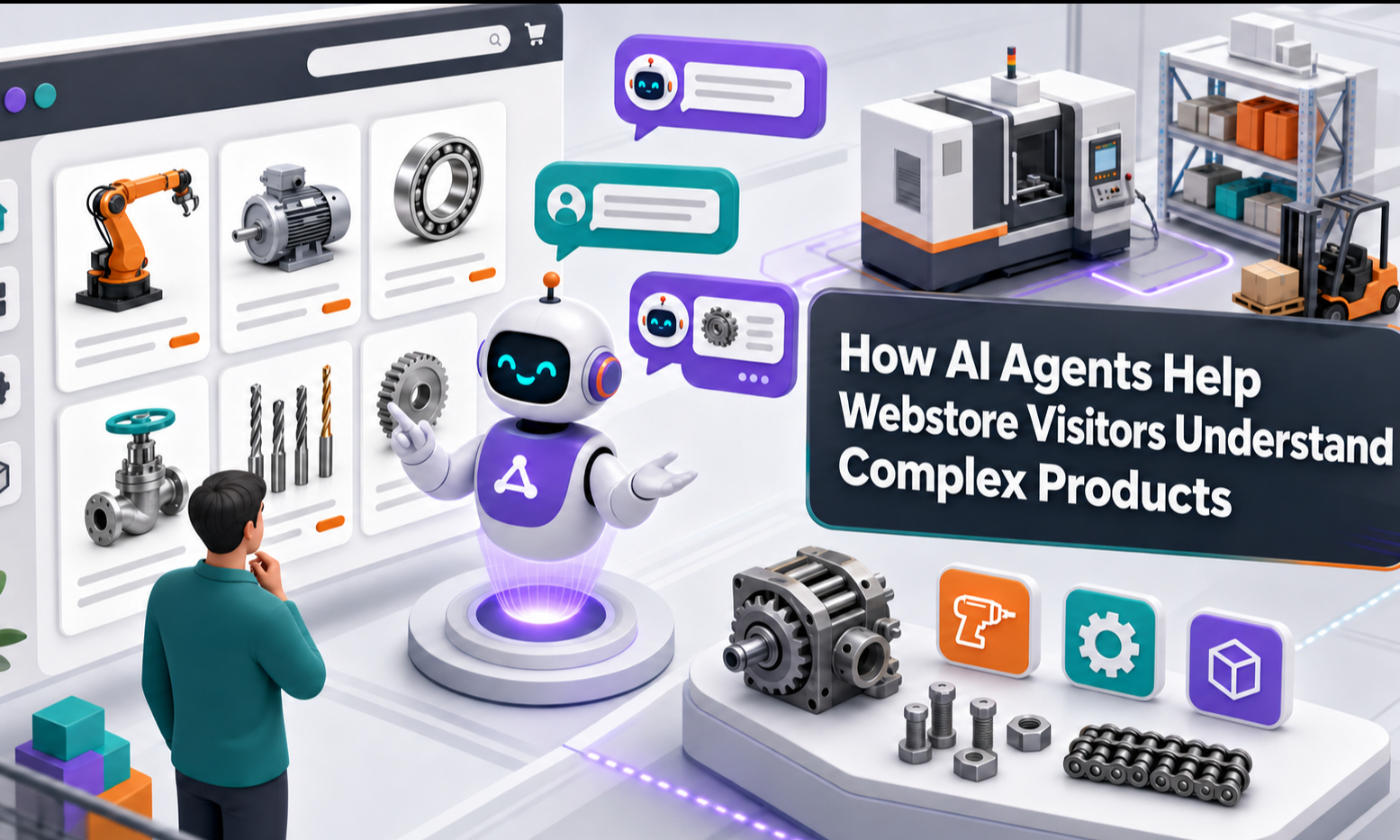
Turn product browsing into guided product discovery with an AI Agent that explains specifications, understands customer requirements, compares options and helps buyers move toward the right product.
Getting customers to your Webstore is only the first step.
The next challenge is helping them understand what they are looking at.
For businesses selling or renting complex products, customers often face hundreds of models, technical specifications, different configurations, rental or purchase options and unfamiliar terminology.
A customer may find your product page but still ask:
“Is this suitable for my application?”
“What does this specification actually mean?”
“Which model should I choose?”
“Do you have something with a higher capacity?”
“Should I rent or buy?”
A traditional Webstore can display the information.
Antbuildz AI Agent helps the customer understand it.
Together, they create a more guided product journey:
Browse → Ask → Understand → Clarify → Compare → Match → Enquire
1. Complex Products Need More Than Product Pages
A normal ecommerce journey works well when the customer already understands the product.
The buyer sees the item, checks the price and makes a decision.
Complex products are different.
Customers may need to understand:
- technical specifications;
- capacity;
- dimensions;
- compatibility;
- operating conditions;
- application suitability;
- configuration;
- rental or purchase options;
- availability;
- delivery requirements.
Even a well-designed product page cannot answer every customer's specific situation.
For example, a forklift page may show:
Capacity: 2.5 tonnes
Power: Electric
Lift height: 6 metres
But the buyer may actually need to know:
“Can this operate in my warehouse with a narrow aisle?”
That question requires more than reading the specification.
It requires understanding the customer's application.
2. Customers Often Know Their Problem, Not the Product
This is one of the biggest challenges in complex-product sales.
Customers do not always know exactly what they need.
They may say:
“I need something to lift pallets to an 8-metre rack.”
instead of:
“I need an 8-metre reach truck.”
Or:
“I need temporary power for several machines.”
instead of knowing the correct generator capacity.
Or:
“I need something to clean a 5,000 sqm warehouse.”
without knowing whether they need a scrubber, sweeper or another cleaning machine.
Traditional website navigation usually expects the customer to know the correct product category or model.
An AI Agent can reverse that process.
Instead of asking:
“Which product are you looking for?”
the conversation can begin with:
“What are you trying to achieve?”
That is a much more natural way for customers to discover complex products.
3. Explain Technical Information in Customer Language
Product pages often contain technical information written for engineers, experienced buyers or industry professionals.
Not every customer understands those specifications immediately.
Antbuildz AI Agent can help explain approved product information in simpler language.
For example, a product page may say:
“Working height: 10 metres”
A customer may actually want to know:
“Can I use this to work on a ceiling approximately 8 metres high?”
Or a specification may say:
“Platform capacity: 230 kg”
The customer may ask:
“Can two workers and their tools use this machine?”
The AI Agent can help translate technical product information into a more understandable conversation while staying within the approved product data.
The objective is not to remove technical detail.
It is to help customers understand what that detail means for their situation.
4. Help Customers Understand Which Specifications Matter
Not every specification matters equally for every application.
A product may have dozens of technical fields.
The customer may only need to focus on five.
For example, someone choosing a reach truck may need to consider:
- load capacity;
- lift height;
- aisle width;
- battery type;
- operating environment.
Someone choosing a generator may need to consider:
- required power;
- load type;
- operating duration;
- fuel type;
- site conditions.
Someone choosing an industrial pump may need to consider:
- flow rate;
- head;
- fluid type;
- solids handling;
- connection size.
The AI Agent can guide the customer toward the information that matters for their specific requirement.
This reduces the need for customers to interpret every specification on their own.
5. Ask the Questions a Salesperson Would Normally Ask
A strong salesperson rarely recommends a product immediately.
They first ask questions.
For example, if a customer says:
“I need a forklift.”
the salesperson may ask:
- What capacity do you need?
- What lifting height?
- Indoor or outdoor?
- What is the aisle width?
- Rent or purchase?
- How long do you need it?
- Where is the site?
- When do you need it?
These questions help turn a vague enquiry into a usable requirement.
Antbuildz AI Agent can follow the same principle.
Instead of immediately giving a generic recommendation, it can identify what information is missing and ask relevant follow-up questions.
The conversation becomes:
Customer Request → Clarifying Questions → Structured Requirement → Product Matching
This is much more useful than simply answering the first question.
6. Compare Products Based on What Matters to the Customer
Complex-product buyers often need to compare several options.
They may want to compare:
- model vs model;
- electric vs diesel;
- smaller vs larger capacity;
- standard vs heavy-duty;
- new vs used;
- rental vs purchase;
- one brand vs another;
- one configuration vs another.
A normal Webstore can show multiple product pages.
But the customer still has to understand the differences.
Antbuildz AI Agent can help explain those differences using the approved product information.
Instead of only saying:
“Model A has 2.5T capacity and Model B has 3T capacity.”
the Agent can help explain:
“If your maximum load is below 2.5 tonnes, Model A may meet the capacity requirement. If you require additional load margin, Model B may be more suitable.”
This helps customers understand not only what is different, but why the difference matters.
7. The AI Agent Can Work With Actual Webstore Products
This is where the connection with AI Webstore Suite becomes important.
The Webstore does more than display product pages.
It provides a structured product environment that the AI Agent can work with.
This may include:
- product categories;
- brands;
- models;
- specifications;
- product descriptions;
- applications;
- rental or sales status;
- pricing information where applicable;
- inventory or availability context where connected;
- product URLs;
- enquiry workflows.
Instead of discussing products only in general terms, the AI Agent can work with the products that the business actually sells or rents.
That creates a much more commercially useful conversation.
8. Move Beyond Simple RAG-Based Question Answering
Retrieval-Augmented Generation, or RAG, is useful for answering questions from approved business knowledge.
For example:
“What is the maximum lifting height of this machine?”
The Agent can retrieve the relevant product information and answer.
But helping a customer choose a product requires another step.
Imagine a customer asks:
“I need an electric reach truck for a narrow warehouse. It needs to lift 1,500 kg to around 8 metres.”
The system needs to understand:
Product type: Reach truck
Power requirement: Electric
Capacity: At least 1,500 kg
Lift height: Around 8 metres
Environment: Warehouse
Constraint: Narrow aisle
It can then compare those requirements against the structured products available in the Webstore.
This is not simply document retrieval.
It is product matching.
Antbuildz AI Agent can combine approved knowledge with structured product data and a decision layer to help narrow products against the customer's requirements.
The flow becomes:
Understand → Retrieve → Query → Compare → Match → Recommend
9. Consider Technical and Commercial Fit
The technically correct product is not always the commercially suitable product.
For example, several products may meet the required specifications.
But:
- one may not be available;
- one may only be available for purchase;
- one may not serve the customer's location;
- another may be available for the required rental period.
Where the relevant information is connected, the AI Agent can consider both technical and commercial context.
Technical Fit This may include:
- capacity;
- dimensions;
- performance;
- compatibility;
- power source;
- application;
- environment;
- configuration.
Commercial Fit This may include:
- rent or purchase;
- availability;
- quantity;
- location;
- rental duration;
- pricing;
- delivery requirements.
This helps move the conversation from:
“This type of product may work.”
towards:
“These products from your catalogue are the closest match based on the information provided.”
10. Help Customers Explore Alternatives
Customers do not always land on the right product first.
Someone may visit a product page and discover that:
- the capacity is too low;
- the machine is too large;
- the specification is not suitable;
- the product is not available;
- another configuration may work better.
A static product page may become a dead end.
An AI Agent can continue the journey.
For example:
“This model may not meet your required lift height. Would you like me to show options with at least 10 metres of working height?”
Or:
“If you need indoor operation, an electric model may be more appropriate. Would you like to compare the available electric options?”
This keeps the customer inside the product journey rather than forcing them to start another search.
11. Support Both Sales and Rental Conversations
The questions required for a sales enquiry may be different from a rental enquiry.
Sales
The Agent may need to understand:
- product requirement;
- quantity;
- specifications;
- delivery location;
- budget;
- purchasing timeline;
- quotation requirements.
Rental
The Agent may need to understand:
- equipment requirement;
- capacity;
- rental start date;
- rental duration;
- project location;
- site conditions;
- delivery requirements.
Antbuildz AI Webstore Suite supports sales and rental businesses, allowing the AI Agent to guide the conversation according to the customer's commercial intent.
This is important because the correct product recommendation may depend on more than specifications.
It may depend on how the customer intends to obtain and use the product.
12. Turn Browsing Into a Qualified Enquiry
One of the biggest advantages of an AI-guided Webstore is what happens after the customer understands the product.
Instead of ending with:
“Contact us for more information.”
the AI Agent can help structure the enquiry before it reaches the sales team.
A vague enquiry might be:
“Interested in forklift.”
A guided enquiry can become:
Product: Electric forklift
Capacity: 2.5 tonnes
Application: Indoor warehouse
Required lift height: 6 metres
Location: Singapore
Intent: Rental
Duration: One month
Start date: Next week
Contact: ABC Engineering
The salesperson receives significantly more context.
They can spend less time repeating qualification questions and more time working on quotation, negotiation and closing.
13. Customers Can Browse When They Know — and Ask When They Don't
This is one of the most important differences between a traditional Webstore and an AI-powered Webstore.
Some customers know exactly what they need.
They want to:
Browse → Find → Enquire
Other customers only understand their requirement.
They need to:
Ask → Clarify → Compare → Discover → Enquire
AI Webstore Suite can support both journeys.
The Webstore serves customers who prefer browsing.
The AI Agent serves customers who need guidance.
Together, they create a more flexible digital sales experience.
14. Keep Customers Engaged When Salespeople Are Not Available
Customers do not only browse during office hours.
They may research products:
- after work;
- during project planning;
- from another time zone;
- during weekends;
- before contacting suppliers.
Without assistance, a customer may find a product page, become confused and leave.
The AI Agent provides an always-available first layer of guidance.
It can answer approved questions, explain product information, clarify requirements and collect enquiry details before a salesperson becomes involved.
This does not replace the sales team.
It helps the sales team engage with customers after more of the initial discovery work has already happened.
15. AI Should Support the Salesperson, Not Pretend to Replace One
Complex B2B purchases often still require human involvement.
A salesperson may need to:
- confirm pricing;
- validate special technical requirements;
- negotiate commercial terms;
- check final availability;
- prepare quotations;
- manage customer relationships;
- close the deal.
The AI Agent's role is to handle more of the repetitive early-stage work.
It can help customers understand products, clarify requirements and prepare a better enquiry.
The salesperson can then focus on the parts of the sales process where human judgement and relationship management matter most.
Frequently Asked Questions
1. How does Antbuildz AI Agent help customers understand products? The Agent can explain approved product information, clarify specifications, ask follow-up questions, compare options and help customers identify products relevant to their requirements.
2. Can customers ask questions directly from product pages? Yes. When deployed with AI Webstore Suite, the AI Agent can support customers while they browse the business's structured product environment.
3. Can the AI Agent recommend products? Yes, where sufficient approved product information is available.
When connected with AI Webstore Suite, the Agent can use structured product information and supported inventory context to help narrow suitable products based on customer requirements.
4. Does the AI Agent only use RAG? No.
RAG can be used to retrieve relevant approved knowledge, but product recommendation may also involve structured product queries and decision logic to compare customer requirements with products in the Webstore.
5. Can the AI Agent compare products? Yes.
Where the relevant product information is available, the Agent can explain differences between products and help customers understand which factors may matter for their application.
6. Can the Agent consider availability? Where inventory or availability information is connected and supported, it can be included as part of the product-matching process.
7. Does the AI Agent replace the sales team? No.
The AI Agent is designed to support customer discovery, product understanding, requirement clarification, lead qualification and enquiry capture.
Human sales teams can continue handling quotation, negotiation, technical confirmation and deal closing where required.
8. Can Antbuildz AI Agent work without AI Webstore Suite? Yes.
The AI Agent can operate independently using approved catalogues, documents, websites, FAQs and other business knowledge.
AI Webstore Suite adds a more structured product, inventory and store layer that can make product discovery and product matching more connected.
From Browsing to Understanding
A Webstore can show customers what you sell.
That does not mean customers automatically understand what they should choose.
For complex products, the real challenge is helping customers move from:
“I found this product.”
to:
“I understand whether this product fits my requirement.”
That is where Antbuildz AI Agent adds value.
The Webstore provides the structured product environment.
The AI Agent helps customers understand, clarify, compare and decide.
And when the two work together, the customer journey becomes:
Discover → Browse → Ask → Understand → Compare → Match → Enquire
Don't make customers figure out complex products alone. Give every visitor a product specialist they can ask.