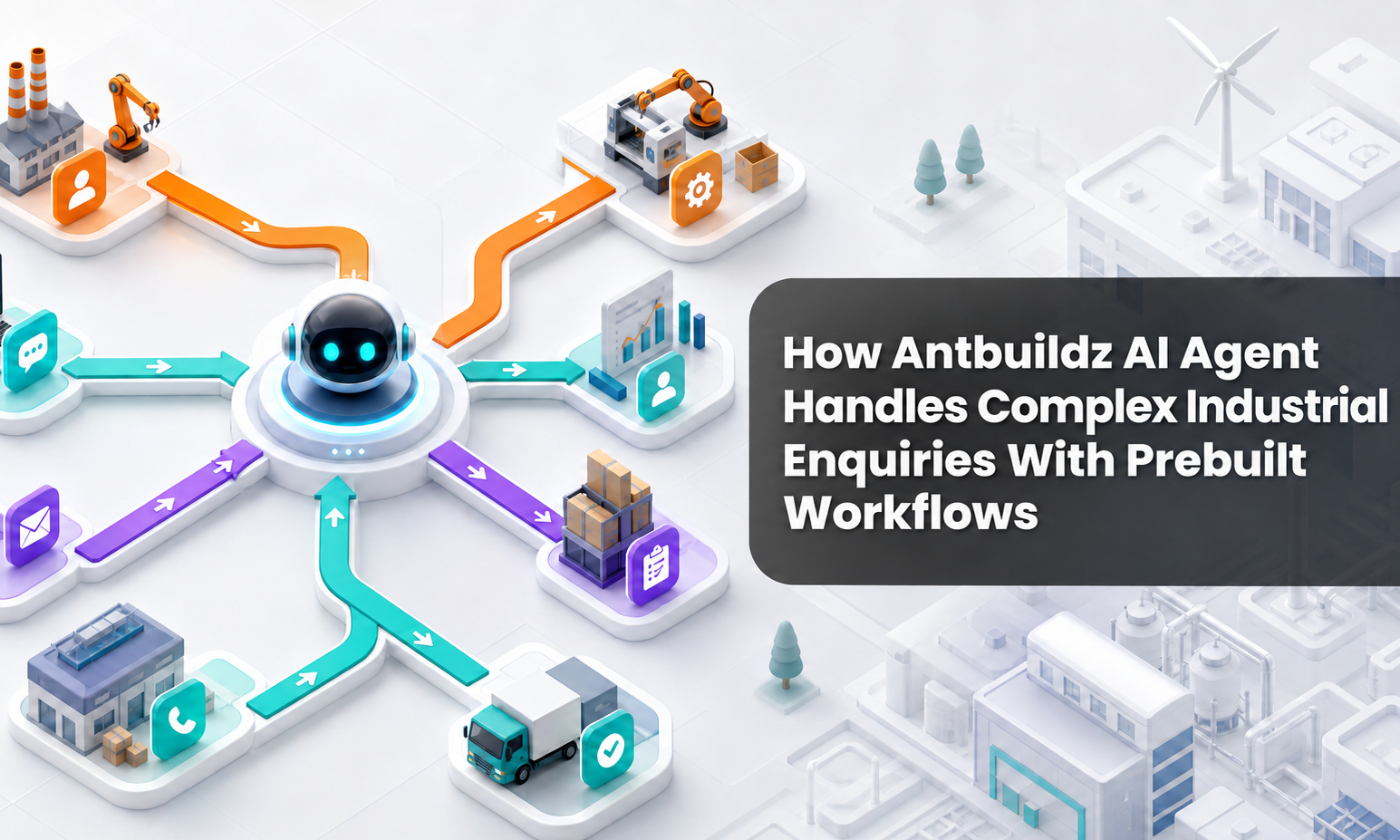
Turn vague industrial enquiries into structured requirements with prebuilt clarification workflows designed around how technical sales conversations actually happen.
Industrial enquiries are rarely simple. A customer may say, “I need a forklift,” “I need a generator,” or “Can you recommend a pump?” These requests sound straightforward, but they usually do not contain enough information to make a reliable recommendation. A good salesperson would first clarify the application, technical requirements, operating conditions and commercial intent before deciding what to recommend.
Antbuildz AI Agent is designed around the same principle. Instead of behaving like a generic chatbot that simply answers the first question it sees, the Agent can use prebuilt enquiry workflows developed around complex industrial and technical sales conversations. These workflows help the Agent understand what information is missing, what should be clarified, when enough information has been collected, what products should be considered and when the conversation should be handed over to a human salesperson.
The objective is not to make the Agent ask more questions. It is to help it ask the right questions at the right time.
1. Industrial Enquiries Usually Start Incomplete
Most customers do not provide everything required in their first message. Someone asking for a forklift may not mention the required capacity, lifting height, aisle width, operating environment, location, rental period or whether they intend to rent or purchase.
Without this information, an immediate recommendation may be inaccurate or commercially irrelevant. This is why clarification is such an important part of industrial sales.
Antbuildz AI Agent can recognise when important information is missing and continue the conversation before moving towards a recommendation. Instead of guessing, it progressively turns the customer's initial request into a more complete requirement.
2. Prebuilt Workflows Help the Agent Understand What Matters
Different product categories require different clarification logic. A forklift customer may need to clarify capacity, lift height and aisle width, while a generator enquiry may require information about power demand, operating duration and the equipment being powered. A pump enquiry may depend on flow rate, head, fluid type and solids handling, while an elevated work platform enquiry may require working height, ground conditions and access restrictions.
This means a generic qualification form is usually not enough.
Antbuildz provides prebuilt workflow structures based on common industrial enquiry patterns. These workflows help guide the Agent toward the information that normally matters for that type of product or application, while still allowing the conversation to remain natural.
3. The Agent Does Not Follow a Rigid Questionnaire
Prebuilt workflows do not mean forcing every customer through the same sequence of questions. The Agent should use information the customer has already provided and only clarify what is still missing.
For example, if a customer says, “I need a 2.5-tonne electric forklift for an indoor warehouse with a 6-metre lifting height,” the Agent should not ask again about capacity, power source or operating environment. Those requirements are already known.
Instead, it may continue with questions such as whether the customer wants to rent or purchase, where the equipment will be used, when it is required or whether there are aisle-width restrictions.
This creates a more natural conversation and avoids making the customer feel like they are completing a long form.
4. Turn Natural Conversation Into Structured Requirements
Customers often describe what they need in an unstructured way. For example, someone may say, “We need an electric reach truck for our warehouse in Tuas. Around 1.5 tonnes, probably 8 metres high, and we need it for about two weeks next month.”
From one sentence, the Agent can already identify useful information such as the product type, power source, capacity, lift height, location, rental duration and expected timing.
The Agent can then focus only on the important missing requirement, such as aisle width or exact starting date.
This is one of the advantages of conversational AI. The customer does not need to understand every technical field or complete a complicated form before receiving help. The conversation itself gradually becomes a structured enquiry.
5. Clarification Should Reflect the Industry
Different industries have different decision factors, and this is where domain-oriented workflow design becomes important.
Someone choosing a forklift may care about capacity, lift height, power source, aisle width and operating surface. Someone selecting a generator may care about power demand, peak load, fuel type, operating duration and site conditions. A pump enquiry may revolve around flow rate, head, fluid type, temperature or solids content.
A generic chatbot may ask reasonable questions, but it may not consistently identify the most commercially or technically important ones.
Antbuildz uses workflow logic to give the Agent a stronger understanding of how these industrial conversations should progress. This allows the Agent to behave more like a trained product specialist rather than a general-purpose chatbot.
6. Separate Technical Requirements From Commercial Requirements
A good industrial enquiry normally has two sides: technical fit and commercial fit.
Technical requirements may include capacity, dimensions, performance, compatibility, configuration, operating environment and application. Commercial requirements may include rental or purchase intent, quantity, location, required date, rental duration, pricing and delivery requirements.
A product may technically suit the customer but still be commercially unsuitable. It may not be available, may only be offered for sale, may not serve the customer's location or may not be available during the required rental period.
Antbuildz AI Agent can use its workflow to clarify both sides of the enquiry before progressing toward product matching or escalation.
7. Ask Only What Is Necessary
A common weakness of automated sales systems is over-questioning. Customers should not have to answer ten or fifteen questions before receiving useful information.
The Agent should prioritise only the information that materially affects the next step.
For example, if the customer already asks for a “3-tonne diesel forklift,” the Agent already knows the product category, capacity and power source. It may only need to clarify lifting height, location, purchase or rental intent and required date.
The goal is not to collect the maximum amount of data possible. The goal is to collect the minimum information required to make a useful decision.
8. Know When to Stop Asking Questions
Clarification is valuable only when it leads somewhere.
Once the Agent has enough information to identify relevant products, compare suitable options, capture the enquiry or hand the conversation to a salesperson, it should move forward.
The customer should not feel trapped inside an endless qualification process.
Depending on the situation, the next step may be to recommend a suitable product, present several matching options, capture an enquiry or escalate the conversation to a human specialist.
A well-designed workflow helps the Agent recognise when enough information has been collected.
9. Connect the Workflow With the AI Webstore Product Library
Clarification becomes much more powerful when it is connected to structured product data.
Suppose the Agent has established that a customer requires an electric reach truck with at least 1,500 kg capacity, around 8 metres of lift height, indoor warehouse use, a narrow aisle, a two-week rental period and a Singapore location.
The Agent can then compare those requirements against the structured products available through Antbuildz AI Webstore Suite.
Instead of simply retrieving a paragraph about reach trucks, the system can begin narrowing the company's actual catalogue toward the closest matching products.
The process becomes:
Clarify → Structure → Query → Compare → Match
This is where the workflow, product data and AI decision layer work together.
10. RAG, Workflow and Product Data Serve Different Purposes
These three layers should not be confused.
RAG helps the Agent retrieve relevant approved knowledge. If a customer asks about the lifting capacity or specifications of a model, retrieval can help find the correct information.
Workflow controls how the conversation progresses. It helps the Agent determine what needs to be clarified and whether enough information has been collected.
Structured product and inventory data supports matching. It allows the Agent to compare the customer's requirement with the company's actual products and available commercial context.
Together, these layers create a much more useful sales experience than relying on a language model alone.
11. Different Enquiries Can Follow Different Paths
Not every customer has the same intention.
A rental enquiry may need to clarify equipment type, capacity, rental start date, duration, site location and delivery requirements. A purchase enquiry may focus more on model, quantity, technical specifications, delivery location and quotation requirements. A technical enquiry may require deeper clarification around application, compatibility or configuration.
A customer who does not know what product they need may follow a different path again. The Agent may begin by asking what they are trying to achieve and progressively narrow the relevant product category.
This allows one AI Agent to support several customer journeys while keeping each conversation relevant.
12. Turn Vague Enquiries Into Sales-Ready Requirements
Without structured clarification, a salesperson may receive an enquiry such as:
“Hi, looking for forklift.”
The salesperson then has to restart the entire discovery process.
With an AI-guided workflow, the enquiry can arrive with much more context. The sales team may already know the required product type, capacity, lift height, application, site location, rental or purchase intent, required date and duration.
This gives the salesperson something actionable.
Instead of spending time repeatedly asking basic qualification questions, the sales team can move more quickly toward availability, pricing, quotation, negotiation and closing.
The AI Agent becomes part of the sales process rather than simply a chat interface.
13. Know When Human Input Is Required
Not every enquiry should be handled fully by AI.
Some requests may involve unusual engineering requirements, custom configurations, complex pricing, contract terms, unavailable information, safety-sensitive decisions or special commercial arrangements.
In these cases, a good AI Agent should know when to stop rather than pretending to have an answer.
The workflow can define when a conversation should be escalated to a technical specialist, salesperson or another designated person.
The objective is not to remove humans from the process. It is to make sure human attention is used where it adds the most value.
14. Create a More Consistent Sales Process
Prebuilt workflows also solve an internal problem.
Different salespeople often qualify enquiries differently. One may ask all the right questions, while another may miss an important detail or recommend a product too early.
By defining the core clarification logic in the AI Agent, businesses can create a more consistent first-stage sales process.
Customers receive a more consistent experience, enquiries arrive with better information, salespeople spend less time repeating the same questions and new team members can rely on a clearer sales structure.
The workflow becomes part of the company's operating knowledge.
15. Prebuilt Does Not Mean One-Size-Fits-All
Antbuildz provides prebuilt workflow structures as a starting point, but every business is different.
A rental company may care heavily about dates, location and delivery. A distributor may focus more on quantity, brand, compatibility and stock. An OEM may need project requirements, technical parameters and engineering review.
The workflow can therefore be adapted around the company's products, commercial process and escalation rules.
The prebuilt structure helps the business start faster, while configuration allows the Agent to reflect how that specific company actually sells.
Frequently Asked Questions
1. What is an AI Agent enquiry workflow? An enquiry workflow defines how the AI Agent should guide different types of customer conversations. It helps determine what information should be collected, which clarification questions should be asked, when the Agent has enough information to proceed and when the enquiry should be escalated.
2. Why not simply let the LLM decide what to ask? A language model can generate reasonable questions, but industrial sales often depend on specific technical and commercial information. Workflow logic helps make those conversations more consistent and aligned with how the business actually sells.
3. Are the workflows fixed? No. Prebuilt workflows provide a starting framework and can be adapted around the company's products, customer journey and sales process.
4. Can the Agent skip information the customer has already provided? Yes. The Agent can use information already given in the conversation and focus on important missing requirements rather than repeating questions.
5. Can different product categories use different workflows? Yes. Different products can require different clarification logic because the factors that determine suitability vary between categories.
6. Can the workflows support both rental and sales? Yes. Rental and purchase enquiries can follow different clarification paths based on their commercial requirements.
7. What happens after clarification is completed? The structured requirement can be used to identify relevant products, compare options, capture a qualified enquiry or escalate the conversation to the appropriate salesperson or technical specialist.
8. Is workflow the same as RAG? No. RAG retrieves relevant knowledge. Workflow determines how the conversation progresses. Structured product data then supports comparison and product matching.
From Generic Chatbot to Industry-Aware Sales Agent
A generic chatbot can answer questions.
An industrial sales Agent needs to understand when the customer has not provided enough information, know what matters for that type of enquiry, ask the right follow-up questions, structure the requirement, connect it with actual products and recognise when human support is needed.
That is why Antbuildz combines industry-oriented workflow logic, approved knowledge, structured product data and a product decision layer.
The objective is not simply to make AI sound more knowledgeable.
It is to make the enquiry process itself more intelligent.
Turn vague enquiries into structured requirements, and structured requirements into better sales opportunities.