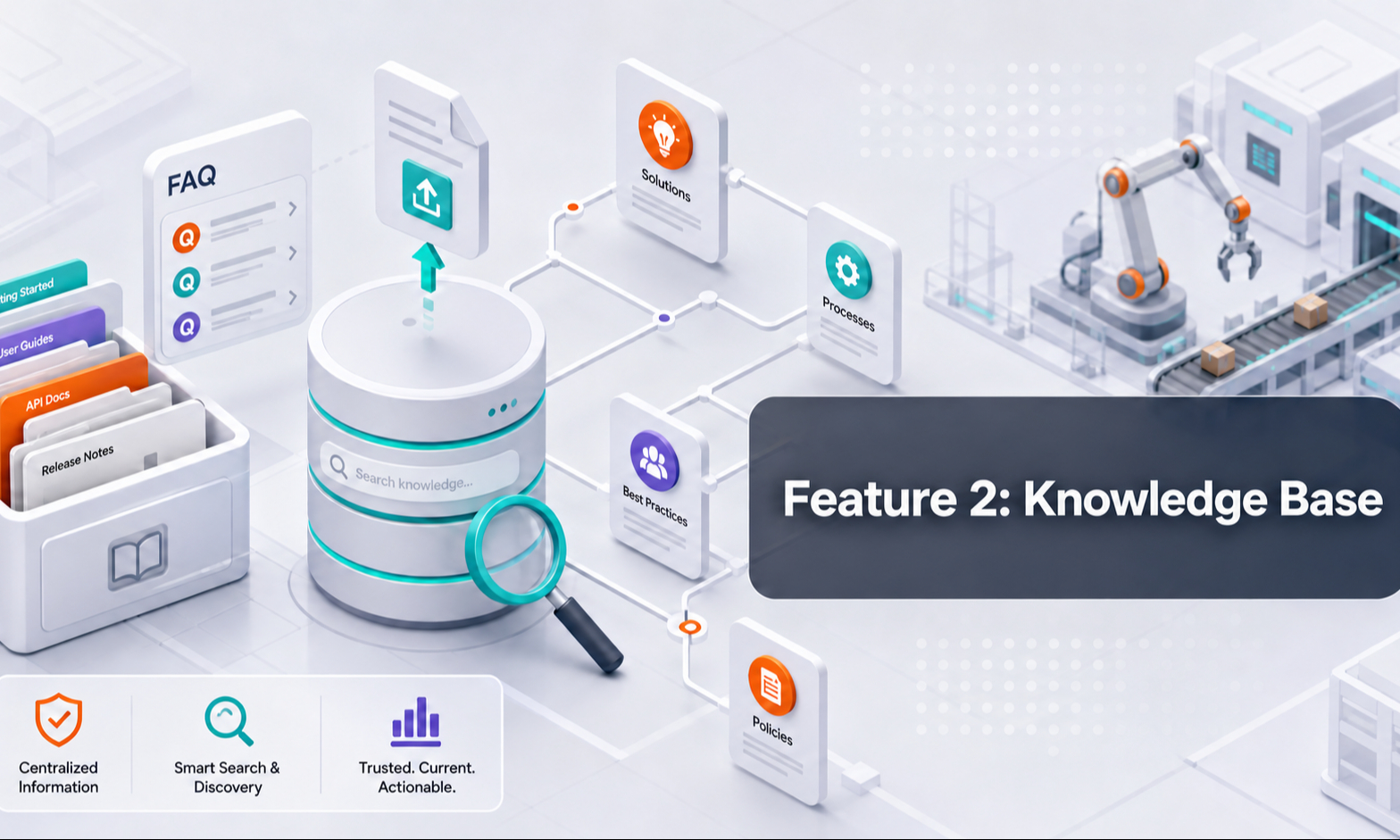
The quality of your AI Agent depends heavily on the quality of the knowledge you provide.
The more relevant and detailed the information, the better the Agent can understand customer questions, explain products, answer technical enquiries and follow your business rules.
This does not mean you need to upload everything before you start.
Begin with your most important knowledge, test the Agent with real customer questions, then improve it over time.
1. Why the Knowledge Base Matters
Objective Give your AI Agent reliable information it can retrieve and use during customer conversations.
The Knowledge Base helps the Agent understand:
- Your company
- Your products and services
- Your operating procedures
- Common customer questions
- Commercial terms
- Technical information
- Product specifications and applications
For businesses selling complex products, this is especially important because customers may depend on specifications, datasheets, manuals, technical tables, charts, compatibility information and product-specific details.
A useful principle is:
The better the knowledge, the better the context your AI Agent has to answer.
2. Knowledge Categories
Objective Organise different types of information so your Agent has the right business context and your team can manage the Knowledge Base clearly.
Terms & Conditions
Use this category for approved commercial and customer-facing terms.
Examples include:
- Payment terms
- Warranty conditions
- Delivery terms
- Rental terms
- Cancellation policies
- Return policies
- Service conditions
- Customer agreements
Use the latest approved version wherever possible.
Standard Operating Procedures
Use Standard Operating Procedures for instructions on how customer enquiries should be handled.
Examples include:
- Sales enquiry process
- Qualification questions
- Quotation workflow
- Lead handling
- Human handover
- Technical escalation
- After-sales process
SOP tells the Agent what to do next, not only what information to provide.
Website Content
Use this category for relevant and approved information already published on your website.
Examples include:
- Company information
- Product pages
- Service pages
- Industry pages
- Resource articles
- Policies
- Support content
Make sure the website information is current and does not conflict with newer documents.
Frequently Asked Questions
Use FAQs for common customer questions with clear, approved answers.
Examples include:
- How do I request a quotation?
- Do you deliver?
- What payment methods do you accept?
- What warranty is provided?
- Do you provide installation?
- What is the lead time?
Keep FAQ answers clear and practical.
Product Knowledge
Use Product Knowledge for detailed information about the products your customers may want to understand, compare or select.
This may include:
- Product name
- Brand
- Model
- Category
- SKU
- Serial number where relevant
- Product description
- Specifications
- Datasheets
- Catalogues
- Manuals
- Technical tables
- Charts
- Diagrams
- Applications
- Compatibility
- Product limitations
- Spare-parts information
For complex products, this is often one of the most important knowledge categories.
Others
Use Others for approved supporting information that does not clearly fit another category.
Avoid using Others as the default for everything. Use the most relevant category whenever possible.
3. How to Add Knowledge
Objective Add approved knowledge using the source that is easiest for your business to maintain.
You can add knowledge through:
- Choose Files — upload documents such as PDFs, Word files, spreadsheets, catalogues, manuals or technical files
- Website — add relevant website content
- Cloud Sources — connect supported sources such as Google Drive where available
- Paste Text — add short FAQs, SOPs, rules or approved information directly
You can also use the Website Crawler to discover and index supported public pages from your website.
After crawling, review the pages to make sure the content being used is relevant and current.
4. How to Prepare Good Knowledge
Objective Give your Agent information that is easy to understand, retrieve and use.
Good knowledge should be:
- Accurate
- Current
- Clear
- Specific
- Relevant
- Consistent
Avoid knowledge that is:
- Outdated
- Contradictory
- Too vague
- Repeated unnecessarily
- Missing important context
For example:
Weak
We usually deliver quickly.
Better
Standard delivery is typically 2–3 business days after order confirmation, subject to stock availability.
The second version gives the Agent much better context.
5. Simple Knowledge Templates
You do not need a special technical format.
Use your existing documents where possible. If you need to create something new, a simple structured format is enough.
SOP Example
Scenario: Customer requests a quotation.
Agent should:
- Identify the product
- Ask for quantity
- Ask for delivery location
- Ask for required date
- Collect customer contact details
- Pass the enquiry to sales if quotation approval is required
Agent should not:
- Confirm final pricing unless approved
- Promise availability unless confirmed
FAQ Example
Question: Do you provide delivery?
Answer: Yes. Delivery is available within our supported service areas. Charges and timing depend on the order and location.
Product Knowledge Example
Product Name: ABC Industrial Sensor
Brand: ABC
Model: X100
Category: Industrial Sensor
Description:
Industrial proximity sensor designed for automated production lines.
Key Specifications:
- Detection range: 10 mm
- Voltage: 12–24 V DC
- Protection rating: IP67
Applications:
Manufacturing automation and conveyor systems.
Supporting Documents:
Datasheet, catalogue and technical manual.
For individual inventory items, you may also include:
- Serial number
- Manufacturing year
- Age
- Condition
- Location
- Availability
- Price
- Actual product photos
6. Quick Tip: Use AI to Help Prepare Your Knowledge
If your existing information is messy or difficult to organise, you can use an AI assistant to help structure it before uploading.
For example:
“Organise the information below into a clear knowledge document for an AI Agent. Keep all factual information unchanged. Structure it into the most relevant sections, such as FAQ, SOP, Terms or Product Knowledge. Highlight anything missing or unclear instead of inventing information.”
For product information:
“Organise the product information below into product name, brand, model, category, description, specifications, applications, limitations and supporting documents. Do not invent missing specifications.”
Always review the result before adding it to your Knowledge Base.
7. More Useful Detail Gives the Agent Better Context
Your AI Agent can use relevant Knowledge Base information during customer conversations.
For example, if you only provide:
Model X100 is an industrial sensor.
the Agent has very little context.
If you also provide:
- Specifications
- Applications
- Limitations
- Compatibility
- Datasheet
- Relevant FAQs
- Sales or technical SOP
the Agent can answer a much wider range of customer questions more accurately.
However, more information is only better when it is correct and relevant.
Do not upload poor-quality information just to make the Knowledge Base larger.
8. Keep Your Knowledge Current
Review your Knowledge Base when important information changes.
Update or remove:
- Old catalogues
- Superseded product specifications
- Expired policies
- Old pricing rules
- Previous agreements
- Duplicate information
If two documents provide different information, decide which source is current.
A large Knowledge Base is not automatically a good Knowledge Base.
Accurate and well-organised knowledge is more valuable than a large amount of outdated information.
9. Start With the Most Important Knowledge
You do not need to upload your entire company library before testing your Agent.
Start with:
- Your most important products
- Common customer FAQs
- Key SOPs
- Current terms and policies
- Relevant company and website information
Then test your Agent in Playground using real customer questions.
If the answer is weak, check whether the Agent is missing useful information or whether the existing information needs to be clearer.
10. Key Takeaway
The Knowledge Base is the foundation of your AI Agent.
It provides the approved information your Agent uses to understand your business, products and customer enquiries.
The more accurate and useful context you provide, the better your Agent can answer.
Start with the essentials, organise the information clearly, test with real questions and improve the Knowledge Base over time.