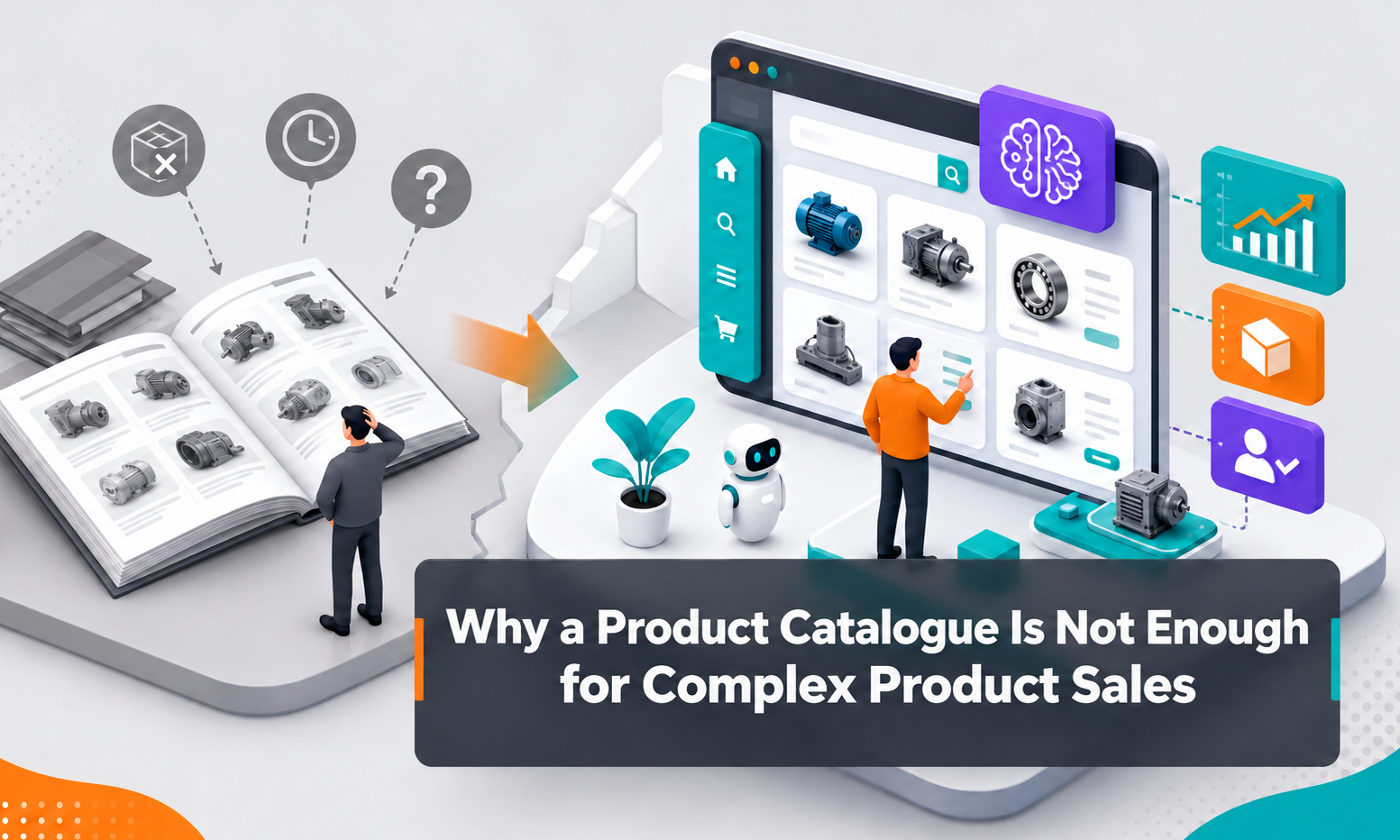
A product catalogue is useful, but for complex industrial products it is rarely enough. Many important product decisions cannot be made by reading a product name, a short description and a few headline specifications. Critical information is often buried inside engineering tables, load charts, performance curves, technical datasheets, model comparison tables and product manuals.
This becomes especially important when a customer asks questions such as, “Can this crane lift 3 tonnes at a 12-metre radius?”, “Which pump size is suitable for this required flow and head?”, or “Which forklift can lift 1.5 tonnes to 8 metres?”. These are not simple keyword questions. The system needs to understand the technical information, interpret the customer’s requirement and reason across the relevant data before it can identify a suitable product.
This is where Antbuildz is designed to go beyond a basic catalogue search or a simple chatbot connected to PDFs.
Complex Product Knowledge Is Often Hidden Inside Technical Documents For many industrial businesses, some of the most valuable product knowledge is not written as normal text. It may be contained inside engineering tables, lifting charts, capacity charts, performance curves, specification tables, dimension drawings, model comparison charts or multi-page technical manuals.
A conventional retrieval system may be able to find a paragraph describing a product, but that does not necessarily mean it can understand the engineering relationships inside a chart or table. For complex products, those relationships often determine whether a product is actually suitable for the customer.
A crane may be marketed as a 50-tonne crane, for example, but that does not mean it can lift 50 tonnes under every operating condition. The actual lifting capacity may depend on the working radius, boom length, configuration, counterweight and outrigger setup. The answer therefore cannot always be found in a single sentence. It may need to be interpreted from a load chart.
The same principle applies to pumps, compressors, generators, forklifts, aerial work platforms and many other technical products.
Why Traditional Text Ingestion Has Limits Many AI systems ingest documents by extracting text and placing that text into a retrieval system. This is useful for questions such as, “What is the maximum working height of this model?” or “What is the rated capacity?”
But technical product selection often goes much further than that.
A customer may ask whether a crane can lift a certain load at a specific radius, whether a pump can meet a required flow and head, whether a generator is correctly sized for a particular set of equipment, or whether a forklift can maintain the required capacity at a specific lift height.
In these cases, the answer may not appear as a sentence anywhere in the document. The AI needs access to the technical relationships contained inside the table or chart.
This is why ingestion quality matters so much for complex-product AI.
Antbuildz Is Designed to Ingest More Than Plain Text Antbuildz’s ingestion system is designed for complex product information, not only simple paragraphs.
The ingestion process can work with product catalogues, technical datasheets, engineering documents, tables, charts and other product knowledge. The goal is to preserve useful technical context so that the AI Agent can retrieve and reason over information such as model specifications, capacity ranges, operating limits, dimensions, performance data, engineering tables and technical relationships.
This distinction is important.
Uploading a document is not the same as making the knowledge inside that document useful to AI.
A company may upload a 100-page catalogue containing dozens of models, technical tables and engineering charts. If the ingestion system captures only the surrounding text but loses the structure of those charts and tables, much of the catalogue’s real technical value is lost.
For Antbuildz, ingestion is therefore not simply:
Upload → Extract Text → Store The objective is closer to:
Upload → Understand Structure → Extract Technical Knowledge → Organise → Retrieve → Reason That creates a much stronger foundation for technical product conversations.
From Retrieval to Technical Reasoning Retrieval-Augmented Generation, or RAG, is useful for finding relevant information. But finding information and making a technical decision are not the same thing.
Imagine a customer says, “I need a machine that can lift 2 tonnes to 16 metres.” The Agent may retrieve several products that mention 16 metres of lift height, but the correct answer may still depend on the load at that height, working radius, machine configuration, attachment or operating conditions.
The system therefore needs to do more than retrieve documents. It needs to understand the customer’s requirement, identify the relevant technical parameters and compare them with the applicable product information.
This is where reasoning becomes important.
Antbuildz AI Agent can use ingested technical knowledge together with structured product information to help narrow products that more closely fit the customer’s requirement.
Use Engineering Tables and Charts as Part of Product Matching For many complex products, a headline specification is not enough to determine suitability.
A pump may have a stated maximum flow rate, but the actual operating point depends on both flow and head. A generator may have a stated power rating, but proper sizing may depend on running load, starting current, equipment type and operating conditions. A forklift may have a nominal capacity, but usable capacity can change depending on lift height, load centre or attachment.
These technical relationships are often stored inside engineering tables and charts.
By making this information available to the AI Agent, Antbuildz can support a more useful form of product selection. Instead of asking only, “Which products contain these keywords?”, the system can work towards a more commercially relevant question:
Which product is the closest technical match for what this customer actually needs? That is a much more valuable problem to solve.
Reasoning and Sizing Are More Valuable Than Simple Search A traditional product search depends heavily on the customer already knowing what to look for.
But many customers do not know the exact model or size they need.
A customer may say, “I need temporary power for two motors and several tools,” rather than asking for a specific generator model. Another may provide a required pump flow and head without knowing which product fits those conditions. Another may know the load and required lift height but not which forklift model is appropriate.
In these situations, the AI Agent needs to move beyond search and support preliminary reasoning or sizing.
That may involve understanding the customer’s requirement, identifying missing information, retrieving the relevant technical data and narrowing the products that best fit the requirement.
The flow becomes:
Understand → Clarify → Retrieve Technical Data → Reason → Size → Match This creates a much more useful digital sales experience than simply presenting a list of products.
The Agent Should Clarify Before It Recommends Technical reasoning is only useful when the input information is sufficient.
If a customer asks, “What generator do I need?”, there is not enough information to make a reliable recommendation. The Agent may need to understand the connected equipment, running power, starting load, voltage, phase, operating duration and site conditions.
The same applies to many other product categories.
Antbuildz can combine its prebuilt enquiry workflows with technical knowledge to clarify the customer’s requirement before progressing toward product matching.
This is important because a good AI Agent should not guess when critical information is missing. It should know what needs to be clarified first.
Connect Technical Reasoning to Actual Products Technical reasoning by itself is not enough.
After identifying the technical requirement, the system still needs to connect that requirement to products the business actually sells or rents.
This is where Antbuildz AI Webstore Suite becomes important.
The Webstore provides structured product information such as product categories, brands, models, specifications, sales or rental options, inventory context and availability where connected.
The AI Agent can combine the technical knowledge extracted from catalogues and engineering documents with the structured product data inside the Webstore.
Instead of stopping at a generic conclusion such as, “You may need a 100 kVA generator,” the system can move toward a more useful commercial outcome:
“Based on your requirement, these products in your catalogue are the closest match.”
This is where technical reasoning becomes commercially valuable.
Combine Technical Fit With Commercial Fit The technically correct product is not always the product the customer can actually buy or rent.
Several products may satisfy the engineering requirement, but one may not be available, another may only be available for purchase, and another may not serve the customer’s location.
A useful recommendation therefore needs to consider both technical and commercial fit.
Technical fit may include specification, capacity, operating limits, performance, application, compatibility and environment. Commercial fit may include inventory, availability, rental or purchase intent, quantity, location, duration, pricing and delivery requirements.
The closest product is therefore not simply the one with the most similar specification.
It is the product that most closely fits the customer’s technical and commercial requirement.
Product Catalogue, Ingestion, Webstore and Decision Layer Serve Different Roles These parts of the system should not be treated as the same thing.
The product catalogue contains the original technical knowledge. The ingestion system makes that knowledge accessible to the AI. The enquiry workflow helps the Agent understand what the customer needs. The AI Webstore provides structured product and inventory information. The decision layer then helps connect these pieces together.
The overall architecture becomes:
Technical Documents → Advanced Ingestion → Knowledge Retrieval combined with:
Customer Requirement → Clarification Workflow combined with:
AI Webstore → Product & Inventory Data leading to:
Decision Layer → Technical & Commercial Matching → Recommendation This is fundamentally different from placing a generic chatbot on top of a PDF library.
Why Better Ingestion Improves Every AI Conversation An AI Agent can only reason from the knowledge it can access.
If important technical information is missing, poorly extracted or incorrectly structured, the final answer will suffer.
This is why ingestion should not be treated as a minor backend function. For complex-product AI, it is one of the most important parts of the system.
Better ingestion can improve specification retrieval, technical comparison, sizing support, product matching and overall answer quality. It also reduces the risk of the Agent overlooking important information contained inside engineering documents.
The quality of the final AI conversation starts with the quality of the knowledge underneath it.
Why This Matters for Complex Industrial Products This approach becomes increasingly valuable as products become more technical.
Examples include cranes, forklifts, aerial work platforms, generators, pumps, compressors, automation equipment, electrical systems, measuring instruments, MRO products, components and spare parts.
These products are often difficult to select using only category, price and a short product description. Customers may need help understanding specifications, interpreting engineering data and comparing several technical conditions at the same time.
That is where advanced ingestion, clarification and reasoning become important parts of the sales experience.
Human Validation Still Matters for Critical Engineering Decisions AI can support technical understanding, preliminary sizing, product comparison and requirement clarification, but not every engineering decision should be fully automated.
Safety-critical applications, unusual configurations, incomplete technical information or high-risk operating conditions may still require validation by a qualified engineer, technical specialist or salesperson.
A good AI system should know when to escalate rather than pretending certainty where it does not exist.
The objective is not to replace engineering judgement. It is to help customers and sales teams reach the right technical information faster and make the early stages of product selection more efficient.
Frequently Asked Questions
1. What types of technical documents can Antbuildz ingest? Antbuildz can work with approved product information such as catalogues, datasheets, manuals, specification documents, engineering tables, technical charts and other product knowledge.
2. Can Antbuildz understand tables and charts? The ingestion system is designed to extract and structure information from more complex technical documents, including tables and charts, so that relevant information can be used during retrieval and reasoning.
3. Can the AI Agent support product sizing? Where sufficient approved technical information and customer requirements are available, the Agent can support preliminary sizing and help identify products that most closely fit the requirement. Safety-critical or specialised engineering applications may still require human validation.
4. How is this different from normal RAG? RAG primarily helps retrieve relevant knowledge. Antbuildz combines retrieval with technical-document ingestion, clarification workflows, structured product data and a decision layer that can support reasoning and product matching.
5. Can the Agent use load charts? Where the relevant load-chart information has been properly ingested and is suitable for the requested analysis, it can be used as part of the technical reasoning process.
6. Can the Agent consider both engineering requirements and inventory? When the relevant product and inventory information is connected, the Agent can consider both technical requirements and commercial context when narrowing suitable products.
From Product Catalogue to Product Intelligence A product catalogue tells you what products exist. A strong ingestion system helps AI understand the technical knowledge inside that catalogue. A clarification workflow helps the Agent understand what the customer actually needs. A decision layer helps compare that requirement with technical information, while the AI Webstore connects the reasoning to the products the business actually sells or rents.
Together, the process becomes:
Ingest → Understand → Clarify → Retrieve → Reason → Size → Match → Recommend That is where Antbuildz moves beyond basic AI search.
Don’t just make your catalogue searchable. Turn your technical product knowledge into intelligence your AI Agent can reason with.