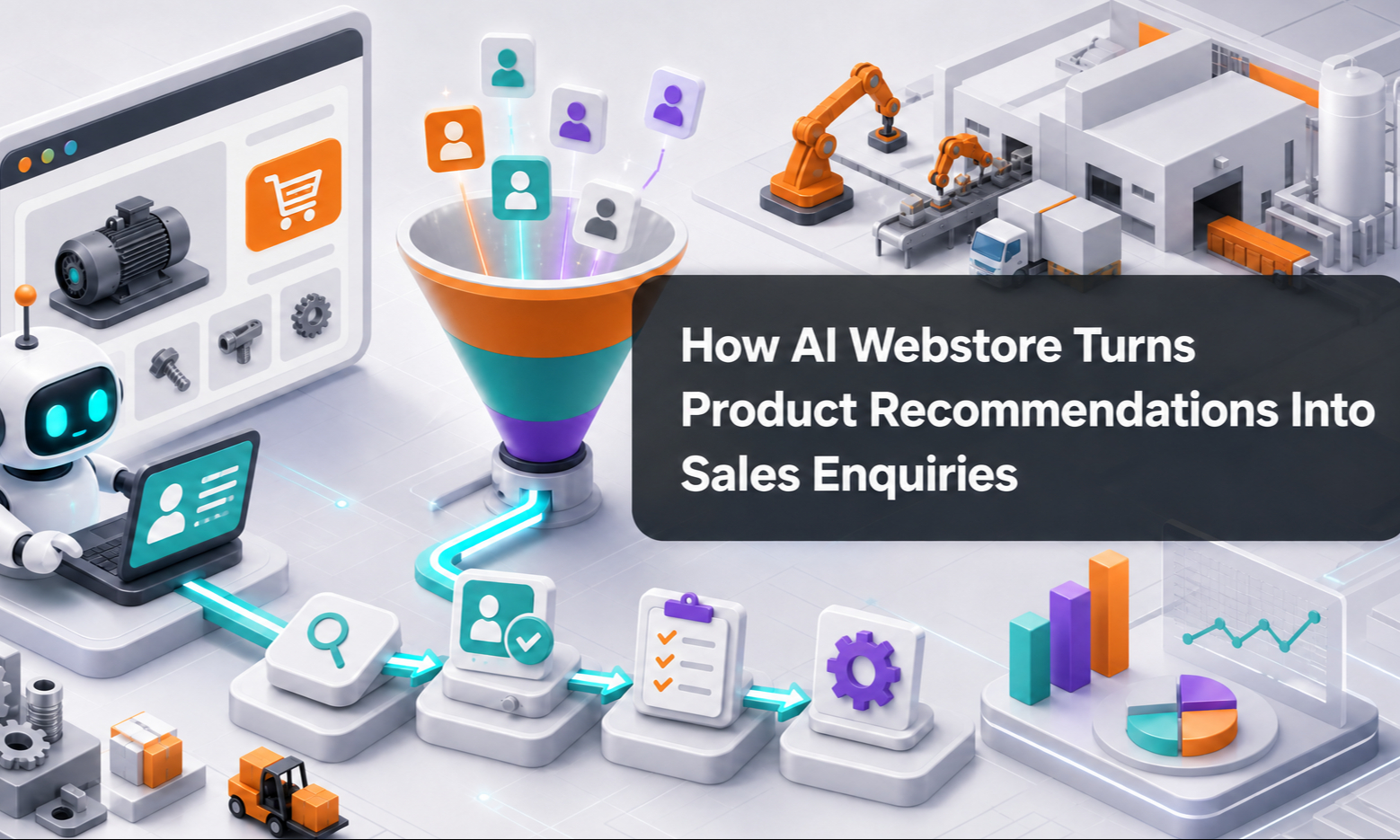
An AI Agent can answer questions and recommend products, but a recommendation alone does not complete the buying journey.
For complex-product businesses, customers usually want to see what has been recommended. They want to review the product image, specifications, model, price or rental information, availability and other commercial details before deciding what to do next.
This is where Antbuildz AI Webstore Suite becomes important.
The Webstore gives the AI Agent a visible, structured product catalogue that customers can actually explore. When the Agent identifies a suitable product, it can connect that recommendation with the relevant product page rather than only describing the product inside a chat conversation.
The customer journey becomes:
Ask → Clarify → Match → Recommend → View Product → Enquire → Negotiate or Book This creates a much more complete digital sales experience.
AI Agent Alone Can Recommend, But the Webstore Makes the Recommendation Visible Antbuildz AI Agent can operate independently using approved product catalogues, technical documents, websites, FAQs and other business knowledge. It can answer product questions, clarify requirements and recommend suitable products based on the knowledge provided.
But without a Webstore, much of that experience still happens inside the conversation.
The Agent may say:
“Based on your requirement, Model X appears to be the closest match.”
That is useful, but the customer may then want to see the product.
What does it look like? What are the full specifications? Is it available for rental or sale? What other models are similar? Is there pricing information? Can I submit an enquiry directly?
AI Webstore Suite provides that next layer.
When the Webstore is connected, the Agent can recommend actual products from the structured catalogue and guide the customer toward dedicated product pages containing the relevant product information.
Instead of only telling the customer what may suit them, the system can help them see, understand and act on the recommendation.
Give Every Recommendation a Real Product Page A product recommendation becomes more useful when the customer can inspect the product immediately.
With AI Webstore Suite, each product can have its own dedicated page containing information such as product images, brand, model, specifications, applications, sales or rental status, pricing where applicable, documents, related products and enquiry actions.
This changes the experience significantly.
Instead of receiving a text-only recommendation such as:
“You may consider a Jungheinrich ETV 216i.”
the customer can receive the recommendation together with the actual product page.
They can then review the image, specifications and commercial information before continuing the conversation.
For complex products, this matters because customers often need both forms of information:
Conversation helps them understand.
Product pages help them verify and explore. The two work better together.
Structured Product Data Also Improves Recommendation Quality The benefit is not only visual.
AI Webstore Suite provides a structured catalogue and inventory layer that gives the AI Agent clearer information about the products the business actually sells or rents.
This may include information such as product category, brand, model, technical specifications, pricing, sales or rental status, availability context, images and product URLs.
That allows the Agent to move beyond recommending based only on text retrieved from documents.
It can work with a clearer representation of the actual product catalogue.
For example, if a customer says:
“I need an electric reach truck that can carry 1,500 kg, lift to 8 metres and work in a narrow warehouse aisle.”
the Agent can first clarify the requirement, then compare it with the structured products in the Webstore and narrow the closest options.
The process becomes:
Understand → Clarify → Query → Compare → Match → Recommend The Webstore makes that recommendation both more structured and more actionable.
Customers Can See the Product Before They Enquire This sounds simple, but it is commercially important.
In a chat-only experience, the customer may need to trust a text response before taking the next step.
With the Webstore, the customer can inspect the recommended product directly.
They can see:
- what the product looks like;
- the exact model;
- relevant specifications;
- available documents;
- sales or rental options;
- related products;
- pricing where shown;
- enquiry or quotation actions.
This creates more confidence before the customer submits an enquiry.
It also reduces the gap between AI recommendation and commercial action.
Instead of:
AI Recommendation → Customer Leaves Chat → Searches Website → Tries to Find Product → Contacts Sales the journey can become:
AI Recommendation → Product Page → Review → Enquiry That is a much cleaner conversion path.
The Webstore Is More Than a Product Catalogue AI Webstore Suite should not be viewed simply as a page where products are listed.
It is a broader digital sales platform.
The current Webstore Suite includes capabilities such as a branded Webstore Builder, structured product catalogue, inventory management, sales and rental workflows, enquiry tools, visitor insights and multilingual product pages, with feature availability depending on plan and setup.
This means businesses can use the Webstore not only to display products, but also to support the way they actually sell or rent them.
A distributor may focus on product enquiries and quotation requests.
A rental company may need start dates, rental duration, location and delivery information.
A supplier may need quantities, specifications and purchase intent.
AI Webstore Suite provides a structured environment for these different journeys.
Support Sales, Rental and Enquiry Workflows Complex-product businesses rarely follow a simple “Add to Cart” process.
A sales transaction may involve product selection, quantity, technical clarification, quotation, negotiation and delivery.
A rental transaction may require product suitability, rental period, start date, location, availability and logistics.
Antbuildz AI Webstore Suite supports structured sales and rental workflows around these kinds of commercial journeys.
The AI Agent can first help the customer understand what they need.
The Webstore then provides the product and commercial layer where the customer can continue toward an enquiry, quotation, negotiation or booking flow.
This creates a connected experience rather than forcing the customer to move between unrelated systems.
From Recommendation to Negotiation Not every customer is ready to buy immediately.
Many B2B transactions require negotiation.
The customer may ask:
“Can you offer a better price for five units?”
“What is the monthly rental rate?”
“Can you deliver next Monday?”
“Can I rent this for three months instead?”
“Is there another model at a lower price?”
These are commercial conversations, not just product questions.
The Webstore can support the commercial structure around the product, while the AI Agent can help guide the enquiry and collect the information needed for the sales team to continue.
This is particularly valuable for complex B2B products where pricing, availability, quantity and contract terms may vary depending on the customer requirement.
Rental Businesses Need More Than a Standard Ecommerce Checkout Rental is especially different from traditional ecommerce.
A customer does not simply choose a product and click “Buy”.
They may need to specify:
- rental start date;
- rental duration;
- project location;
- delivery requirements;
- equipment capacity;
- application;
- quantity;
- availability requirements.
The Webstore provides the rental-facing product experience, while the AI Agent helps clarify the requirement before the customer proceeds further.
The journey can become:
Find Product → Ask Questions → Confirm Suitability → Select Rental Requirement → Submit Enquiry or Booking Request This is much closer to how equipment and industrial rental actually works.
Inventory Context Makes Recommendations More Commercially Relevant Technical suitability is only one part of the problem.
A product may be technically perfect but commercially useless if it is unavailable.
When supported inventory information is connected, Antbuildz AI Agent can use catalogue and recorded availability context to narrow more relevant options. Inventory connections and update frequency depend on the customer's plan and setup.
Imagine three products meet the technical requirement.
One is unavailable.
One is only available for purchase.
One is available for rental during the requested period.
A better AI recommendation should consider that commercial context rather than simply showing all three products.
This is where Webstore + inventory + AI Agent becomes much more powerful than a standalone chatbot.
Product Pages Help the Sales Team Too The Webstore does not only help customers.
It also gives sales teams a consistent product reference.
Instead of sending customers screenshots, PDFs or manually copied specifications, salespeople can share a dedicated product page.
The customer sees the same product information that the AI Agent uses.
This creates a more consistent experience across AI conversations, website browsing and human sales follow-up.
The Webstore becomes the visible product layer for the entire sales process.
Turn Product Browsing Into Qualified Enquiries The Webstore also helps capture better sales information.
Instead of receiving a vague enquiry such as:
“Interested in this machine.”
the system can collect information such as product selection, quantity, sales or rental intent, location, timing, contact details and other relevant requirements.
The AI Agent can clarify these requirements conversationally before the customer submits the enquiry.
For example, the sales team may receive:
Product: Electric reach truck
Model: ETV 216i
Requirement: 1,500 kg at 8 metres
Intent: Rental
Duration: Two weeks
Location: Singapore
Required date: Next month
Customer: ABC Engineering
This gives the salesperson much more context before follow-up.
They can spend less time repeating basic questions and more time confirming availability, preparing quotation, negotiating and closing.
Product Discovery Can Continue After the First Recommendation The first product recommended is not always the final choice.
The customer may discover that the product is too large, too expensive, unavailable or missing a required specification.
Because the Agent is connected to the structured Webstore catalogue, the conversation does not need to stop.
The customer can ask:
“Do you have something smaller?”
“Can you show me another brand?”
“What is the cheaper option?”
“Do you have one available for rental?”
The Agent can continue exploring alternatives from the business's actual catalogue and direct the customer toward the relevant product pages.
This keeps the customer inside the sales journey.
The Webstore Also Builds Long-Term Product Visibility The Webstore has another role beyond conversion.
Each structured product page also creates a dedicated digital identity for the product, including its own page and URL. This supports product discovery through SEO and AI-driven search, although rankings or AI citations cannot be guaranteed.
That means the same product pages serve two purposes.
They help new customers discover the business.
And once customers arrive, they give the AI Agent a visible product environment that can support recommendation and conversion.
The journey becomes:
Search or AI Discovery → Product Page → AI Conversation → Product Matching → Recommendation → Enquiry That is much more powerful than treating the Webstore as only an online catalogue.
AI Agent Alone vs AI Agent With AI Webstore Suite Antbuildz AI Agent can work independently. It can use approved catalogues, PDFs, websites, FAQs and other business documents to answer questions, provide guidance and recommend suitable products.
AI Webstore Suite adds a much richer product and commercial layer.
With the Webstore connected, the customer can browse actual products, see dedicated product pages, view images and specifications, explore sales or rental options and continue into structured enquiry workflows. The Agent also gains access to a more organised catalogue and supported inventory context for product matching.
The difference is simple:
AI Agent helps the customer understand what they may need. AI Agent + AI Webstore Suite helps them understand, see, compare and act on the actual products your business offers.
Frequently Asked Questions
1. What does AI Webstore Suite add to Antbuildz AI Agent? AI Webstore Suite adds a structured product catalogue, dedicated product pages, images, specifications, inventory context and sales or rental workflows. This gives the Agent a clearer product layer and gives customers a visible product experience after receiving a recommendation.
2. Can the AI Agent work without a Webstore? Yes. Antbuildz AI Agent can operate using approved product catalogues, PDFs, websites, FAQs and business documents. The Webstore becomes valuable when the business wants structured product pages, inventory context and integrated sales or rental workflows.
3. Can the AI Agent recommend actual products from the Webstore? Yes. When connected with AI Webstore Suite, the Agent can use structured product and supported inventory information to narrow suitable products and direct customers toward the relevant product pages.
4. Can customers see product images and specifications after a recommendation? Yes. Dedicated Webstore product pages can contain product images, specifications, commercial information, documents and enquiry actions.
5. Does AI Webstore Suite support rental businesses? Yes. Rental+ includes rental capabilities in addition to sales functionality, while specific workflows and features depend on the selected plan and setup.
6. Does the Webstore include inventory management? Yes. AI Webstore Suite includes catalogue and inventory management capabilities. Inventory connections and update frequency depend on the customer's plan and configuration.
7. Can customers submit quotation or enquiry information through the Webstore? Yes. The Webstore includes enquiry tools designed to collect information such as product selections, quantities, timelines, locations and customer contact details.
From AI Recommendation to Commercial Action An AI Agent can tell a customer what may suit their requirement.
A connected AI Webstore can take the customer further.
It gives the recommendation a real product page.
It gives the customer something they can see, verify and compare.
It gives the AI Agent structured product and inventory information.
And it gives the business the tools needed to move the customer into sales, rental, enquiry, negotiation or booking workflows.
The full journey becomes:
Discover → Ask → Clarify → Match → Recommend → View Product → Compare → Enquire → Negotiate or Book That is the real value of connecting Antbuildz AI Agent with AI Webstore Suite.
Don't stop at recommending the right product. Give customers a clear path to see it, understand it and take the next commercial step.